TOUR {{ tourN }} / 5 · {{ tourLabel }}

{{ tourText }}

Skip to content
Briefing
ESC
TRY
PYCALYST governs the agentic workforce.

AI can act.
PYCALYST decides when it should.

PYCALYST is the trust infrastructure the AI workforce depends on.

Bind AI-worker identity to mission and authority. Authorize each action against current security state. Enforce runtime boundaries and preserve verifiable evidence.

Establish identity. Constrain authority. Enforce execution. Verify outcomes.

ALLOW·STEP-UP·DEFER·DENY·EVIDENCE— governed continuously, evidenced throughout
Identity → Mission → Authority
Verdict → Permit → Barrier
Credential → Tool → Evidence
PYCALYST

Agentic ID

Example data
Worker · PYC-AW-04218
Treasury Reconciliation Agent
Foundry Financial · Production · G3
Mission
Month-End Reconciliation
Standing authority
Finance Read + Scoped Write
Security state
Verified · Current
Latest verdict
ALLOW WITH BOUNDS
Explore Agentic ID
Evidence trail
  1. VerdictALLOW WITH BOUNDS
  2. Permitledger.export · single use
  3. Barrierre-checked · fresh
  4. Credentialscoped · expiring
  5. Outcomeverified · complete
Lineage b7d4…88c0Integrity verified ✓
CONTROL PATH · EXAMPLE FLOW{{ heroStatus }}
{{ r.mark }} {{ r.label }} {{ r.sub }}

Every AI worker needs an identity.
Every action needs authority.

Connect each AI worker to its mission, permissions and current security state. Enforce boundaries at execution and preserve evidence of what happened.

Explore Agentic ID
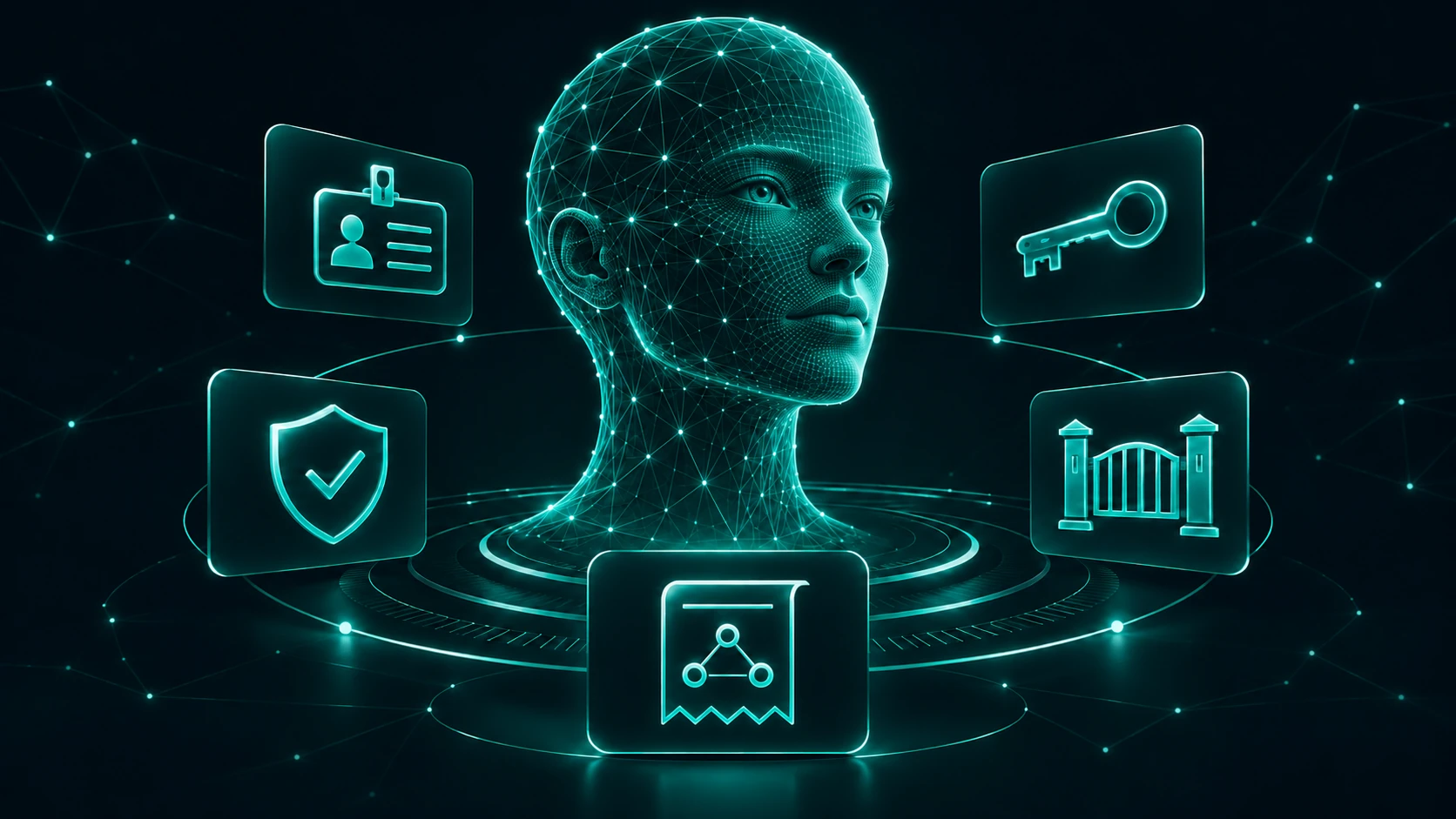
A gender-neutral digital AI identity surrounded by identity, authority, permission, enforcement and evidence symbols.
Inside the protection mechanism

Six control domains. Explicit trust boundaries.

Separate identity, authority, risk, credentials and evidence. Keep each control accountable.

{{ cCore }}

{{ cTitle }}

{{ cBody }}

{{ law.t }}
Moments of consequence

Six exposure scenarios. Governed response.

AI actions create enterprise exposure. Trace each scenario to its governing controls.

Sensitive-data exposure
OUTCOMEConstrain sensitive workflows with purpose-bound authority and credential release.
CONTROLMission + AuthorityGrant + Trust Verdict + ExecutionPermit + SecurityStateBarrier + purpose-bound credential.
EVIDENCEDecision, permit, invocation and outcome lineage.
SEE THE CONTROL PATH
Delegation and subagent risk
OUTCOMEScale delegated work within explicit authority bounds.
CONTROLBounded delegation, Agentic ID identity, autonomy safety, multi-agent trust controls.
EVIDENCEDelegation, scope and agent-to-agent lineage.
SEE THE AGENTIC ID
Mid-execution trust change
OUTCOMEBlock dispatch when trust becomes stale, revoked or unsafe.
CONTROLSecurityStateBarrier + freshness + revocation + current-state admission.
EVIDENCEBarrier decision and preserved execution state.
SEE RUNTIME ADMISSION
Anomalous AI-worker behavior
OUTCOMEInvestigate, contain and remediate through governed SecOps controls.
CONTROLThreat Intelligence + UEBA + Security C2 + governed remediation path.
EVIDENCEFinding → review → decision → response lineage.
SEE SECURITY C2
Authorization under scrutiny
OUTCOMEReconstruct the exact trust path behind a consequential action.
CONTROLDecisionRecords, evidence lineage, WORM / retention controls where configured.
EVIDENCEAttributable identity, authority, decision, execution and outcome chain.
SEE ASSURANCE
Multi-tenant service operations
OUTCOMEDeliver managed AI-security operations with customer-scoped trust boundaries intact.
CONTROLTenant isolation, delegated administration, customer-scoped trust roots, partner workflows.
EVIDENCECustomer-specific operational and assurance records.
SEE MSP / MSSP
Accepted capability · Sensitive Workload Assurance

Sensitive workloads. Verified execution paths.

Bind provider, model, version, route, region, environment and authority to the approved action. Verify the observed outcome.

MODEL APPROVAL
Provider approval is explicit and mission-specific.

Sensitive missions use only approved provider, model, route and region combinations.

ROUTE ASSURANCE
Route approval is exact, versioned and continuously evaluated.

Material route changes trigger reassessment rather than inheriting previous trust.

AUTHORITY
Credential release follows validated identity, mission and authorization.

Credentials are released only inside an already-governed execution path.

INDEPENDENT EVIDENCE
Provider receipts are evidence inputs.

PYCALYST independently verifies the governed execution path and preserves evidence of what occurred.

FAIL-CLOSED ASSURANCE

Sensitive routes execute only when required assurance is established; otherwise the path fails closed.

The architectural distinction

Runtime authorization. Enforced through execution. Security is what the control path permits.

Translate security context into explicit authorization, bounded execution and verifiable evidence.

Monitoring tells you what happened. PYCALYST governs whether it should happen.

Common pattern
What it tells you
What PYCALYST decides
Risk / behavior score
How likely something is to be unsafe.
An explicit ALLOW, DENY, DEFER or STEP-UP — with its basis preserved. Scores enrich context; policy and current state determine the verdict.
Agent identity
Who a session claims to be.
A lifecycle-bound Agentic ID with generation, tenant, environment and provenance — revocable independent of runtime.
Policy engine
Which rules apply to a request.
Decision kept separate from a bounded execution permit and current-state admission at dispatch.
Secrets vault
Where credentials are stored.
Credentials are brokered after authorization succeeds — purpose-bound and minimum-scope.
Observability / SIEM
What happened, as telemetry.
Evidence correlated to decision and execution lineage — proof of the trust path, not just logs.
Approval workflow
A human said yes, once.
Approval is bound to the decision it supports and preserved as evidence.
When trust changes mid-flight

Trust is continuously re-evaluated.

Identity, authority and threat conditions change. Revalidate execution eligibility immediately before effect.

Explore runtime admission
T0
ALLOW — verdict issued
Within mission scope. Permit bounded to action and target.
T1
Security state changes
Anomaly detected. Trust context revoked before dispatch.
T2
Barrier stops execution
Current-state admission revalidates eligibility immediately before effect and fails closed when state has changed.
T3
Evidence records the whole path
Decision, state change and blocked dispatch remain attributable and provable.
Proof, not promises

Reconstruct the trust path behind every action.

Correlate authorization, execution controls and observed outcomes into verifiable evidence.

DECISION LINEAGEIdentityMissionAuthorityPolicyVerdict + basis
EXECUTION LINEAGEPermitBarrier checkCredentialExact ToolAction
OUTCOME PROOFObserved outcomeVerificationDurable evidence✓ Reassessment / revocation
Through each buyer's lens

One trust model. Every accountable team.

Security, operations and assurance share one attributable control model.

CISO / Security leadership
Enterprise AI risk and control posture

One control model for what the AI workforce may do — and proof it held.

Security architecture
Trust boundaries and enforcement design

Explicit separation of identity, authority, decision, permit, barrier and credential.

SOC / Detection & response
Threat, behavior and response

AI-worker context in investigation, containment and coordinated response.

GRC / Audit
Evidence-backed readiness

Control mapping, durable evidence and continuous readiness for security review.

MSP / MSSP
Delegated multi-tenant governance

Operate customer estates without collapsing tenant or environment boundaries.

IAM / Identity governance
AI-worker identity and authority

Bind identity, mission, delegated authority and revocation state to the worker that acts.

Platform / DevSecOps
Governed delivery and execution

Carry trust checks into AI delivery, runtime admission and tool execution with bounded, purpose-specific authority.

Procurement / Risk
Reviewable trust posture

Evaluate control boundaries, shared responsibility and evidence before enterprise adoption.

PYCALYST — Platform

A closed-loop trust system.
Every action inside the loop.

Connect identity, authorization, runtime enforcement and SecOps in one evidence loop. Keep signals, credentials and approvals within their distinct control boundaries.

PYCALYST

AI WORKFORCE TRUST INFRASTRUCTURE

From identity to evidence.

A connected model for agentic work.

OVERSIGHT
  1. 1

    Identity

    PYCALYST Agentic ID

  2. 2

    Mission

    Purpose and scope

  3. 3

    Authority

    Rights and boundaries

  4. 4

    Decision

    Evaluate the request

  5. 5

    Permit

    Permission for the action

  6. 6

    Barrier

    Enforce the boundary

  7. 7

    Evidence

    Record the outcome

Establish context: Identity → Mission

Control execution: Authority → Decision → Permit → Barrier

Retain proof: Evidence

Identity defines who. Mission defines why.

Oversight connects purpose, permission and evidence.

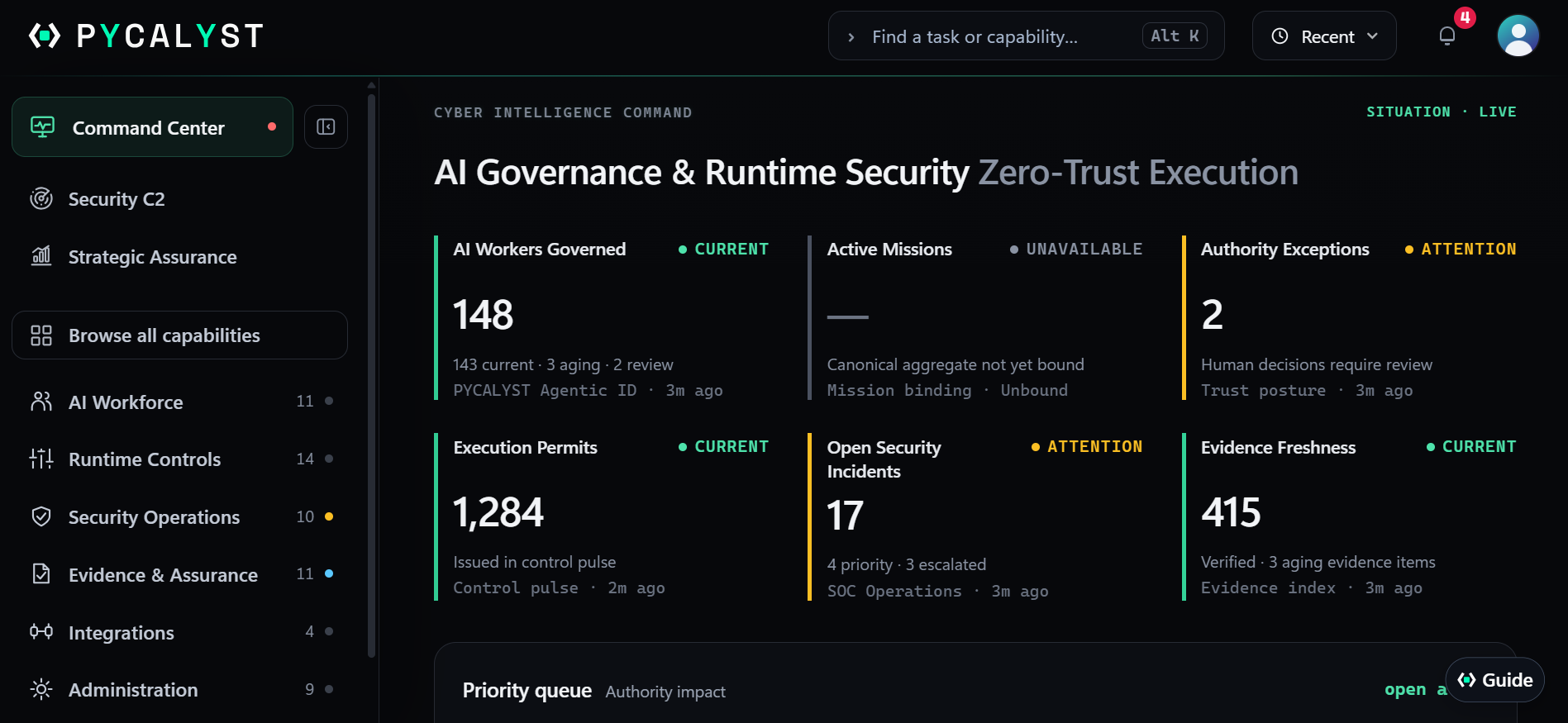
Operational surface · Current Console

See trust become operational.

One operational view of AI-worker identity, authority, runtime posture, SecOps and evidence. The underlying trust path enforces control decisions.

Identity + authorityCurrent trust stateEvidence lineage
PYCALYST ConsoleExample data · Governed view
PYCALYST Console Command Center showing the current Cyber Intelligence Command view with AI workforce posture, authority decisions, security incidents and the live trust-spine control path.

Console preview · Demo data

Closed loop

Discover. Govern. Verify. Revoke.

Carry lifecycle governance into runtime admission. Verify execution outcomes and reassess trust.

PYCALYST AGENTIC ID
GOVERNED TRUST RECORD
01 DISCOVER
02 IDENTIFY
03 VERIFY
04 AUTHORIZE
05 OBSERVE
06 REVOKE
01 DISCOVER

AI workers, tools, models, shadow AI and exposure.

02 IDENTIFY

Durable Agentic ID and lifecycle state.

03 VERIFY

Trust, posture, freshness, route assurance and execution context.

04 AUTHORIZE

Mission bounds and a deterministic decision.

05 OBSERVE

Runtime execution, anomalies, threats and outcomes.

06 REVOKE

Restrict unsafe authority, permits and execution paths.

Execution spine

Distinct controls. Explicit authority.

PYCALYST keeps tokens, scores, approvals and network context in their proper roles within a governed decision path.

1
PYCALYST Agentic ID
Identity + lifecycle
Who
2
Mission & Authority
Purpose + standing bounds
May ever
3
Trust Verdict
Governed decision outcome
Should now
4
Execution Permit
Bounded eligibility
Exactly what
5
Security State Barrier
Current-state admission
Still safe
6
Credential + Tool Control
Least privilege + exact invocation
Effect
7
Verification & Evidence
Outcome + proof + reassessment
Prove

“Given everything we know about this AI worker right now, should it be trusted to perform this specific action, under this mission, with this authority, in this environment?”

IdentityLifecycle-bound
AuthorityExplicit upper bound
ExecutionPermit + current barrier
OutcomeVerified + evidenced

Composable security. Defined control planes.

Capabilities live in distinct control planes, allowing analytics to enrich decisions while authority remains explicit.

Trust Plane
Decides whether to trust
Enforcement Plane
Constrains how it executes
Evidence Plane
Proves what happened
Governance & Trust

Identity, mission, authority, policy, decisions, AIRAM, sensitive workload assurance and regulated controls.

Execution Control

Execution permits, Security State Barrier, orchestration admission and revocation interfaces.

Credential & Tool Control

Credential brokering, governed ToolActions and governed invocation through the Tool Gateway.

Security Operations

Security C2, SOC, SIEM interoperability, threat intelligence, UEBA, testing and remediation.

Context & Evidence

Relationship context, verification, explainability, evidence, durable retention and portable trust.

Customer & Partner Experience

Customer console, MSP/MSSP operations, reports, artifacts and controlled administration.

Map this architecture to your environment.

We map the closed loop to your identity, runtime, SIEM and cloud stack.

PYCALYST — Capabilities

One platform
across the AI workforce trust surface.

Map your risk to the right controls: AI identity, runtime enforcement, model security, SecOps, DevSecOps and evidence. Nine interoperable capability families support enterprise and managed delivery.

60+
PRODUCT CAPABILITIES
9
FAMILIES
1
CONTROL PATH
EXPLORE THE ATLAS · NINE FAMILIES
ARCHITECTURE ANCHORThe Two Gateways
VIEW THE ATLAS AS —

{{ personaLine }}

Autonomy Safety capability portrait showing one primary AI worker coordinating bounded work units while an out-of-bounds branch is constrained.
CAPABILITY PORTRAIT · PUBLIC ABSTRACTION · AUTONOMY SAFETY
Buyer map: NHI · PAM · JIT

Identity, Authority & Governed Execution

Non-human identity (NHI), cryptographic binding and lifecycle governance establish who acts. Explicit authorization and runtime admission constrain what executes.

Identity establishes who the worker is; explicit authorization governs what it may do.

PYCALYST Agentic ID
NHI · AI agent identity
Secure Onboarding
Provenance-verified issuance
Mission & Authority
Purpose + authority ceiling
Trust Verdicts
Deterministic decisions
Execution Permits
JIT · bounded eligibility
Security State Barrier
Current-state admission
Credential Broker
PAM-style short-lived credentials
Tool Registry
Governed ToolActions
Tool Gateway
Governed enterprise actions
Buyer map: Shadow AI · AI governance · Model risk

AI Security, Shadow AI & Model Governance

Expose shadow AI, govern model use and assess runtime risk across your AI estate.

Shadow AI Discovery
Unsanctioned AI · OAuth / SaaS / extensions / agents
AI Gateway
Governed model / API traffic
Route assuranceProvider evidence correlation
Model Registry
Approved provider · model · version · route
Sensitive Workload Assurance
provider · model · version · route · execution environment
Data & Model Lineage
Fine-tuning provenance · output lineage
AIRAM
AI risk assurance · model risk
Runtime Evaluation
Safety / quality · hallucination + policy checks
Drift Management
Continuous drift monitoring · MLOps
The two gateways — different problems, both governed
AI Gateway
GOVERNS MODEL TRAFFIC

Govern model requests and responses across approved API routes.

Model routing Prompt / completion interception Sensitive-data redaction Secret blocking Prompt-injection defense Route / policy binding Token / cost controls
Tool Gateway
GOVERNS ENTERPRISE ACTIONS

Enforce enterprise actions after identity, authorization, permit and current-state checks.

Exact ToolAction binding Target verification Permit + barrier enforcement Brokered credentials Outcome verification
Buyer map: HITL · multi-agent security

AI Workforce Operations

Orchestrate AI workers with explicit ownership, bounded delegation and human oversight.

Create→Inventory→Assign→Orchestrate→Supervise→Constrain→Collaborate
Agent Factory
Governed creation · onboarding
Fleet Management
Inventory · generations · state
Work Orchestration
Intake · dispatch · scheduling · dependencies · completion · quality
Human Oversight
HITL · review/override · output holds · takeover · escalation
AI Safety Guardrail
Constrained autonomy · delegation bounds
Multi-Agent Mesh
Governed agent-to-agent collaboration
Buyer map: SIEM · UEBA · SOAR · BAS · PTaaS

Security Operations & Adversarial Validation

Enrich your SOC with AI-worker context. Validate attack paths through authorized testing and governed remediation.

Governed adversarial validation flow
SCOPE
SIMULATE
OBSERVE
REVIEW
REMEDIATE

Testing feeds governed review and remediation decisions.

Threat Intelligence
Adversary + indicator context
UEBA
Behavioral baselines · drift
SIEM Interoperability
SIEM / SOAR projection
Security C2
Incident command · oversight
AI Red Teaming
Governed adversarial testing
BAS & Governed PenTest
PTaaS · attack-path validation
AI Attack Simulation
Prompt injection · exfiltration · tool abuse
Remediation & Verification
Governed response · re-test proof
Detections, Alerts & Investigations
Cases · incidents · response
Security Gate
Evidence-gated advancement
DERIVED SECURITY VIEWS & ANALYSISCOMPUTED FROM GOVERNED EVIDENCE & CONTEXT
Attack Paths
Exposure routes to consequence
Identity Blast Radius
Reach of a compromised identity
AI-Agent Blast Radius
Reach of a compromised worker
Control Twins
Modeled control state · what-if
Change Simulation
Consequence before rollout
Compliance Impact
Control consequence · mapping
Buyer map: DevSecOps · AppSec · SBOM

DevSecOps & Software Supply Chain

Secure the pipelines that build and ship AI workers with security gates across build and deployment promotion. Production authorization follows its own controlled release path.

Replaceable security engines feed a governed PYCALYST decision and evidence chain.

Secure CI/CD
Pipeline security gates
Code & Dependency Scanning
SAST · DAST · SCA
SBOM & Provenance
Artifact + model provenance
Deployment Approvals
Governed promotion gates
Workload Identity
Pipeline + runtime identity
Runtime Hardening
Supply-chain verification
Secret Scanning
Credentials never ship
IaC Security
Infrastructure-as-code checks
Container Security
Image + runtime posture
Pipeline Security Gates
Policy gates across CI/CD
Buyer map: GRC · CCM · WORM evidence

Evidence, GRC & Assurance

Integrity-protected evidence for control assurance, audit review and regulatory scrutiny.

Immutable Evidence
WORM / object-lock retention
Legal Hold & Integrity
Evidence integrity · holds
Continuous Control Assurance
Continuous controls monitoring
Compliance Mapping
Control mapping · GRC operations
Reports & Exports
Auditor / customer evidence packages
Buyer map: governed integrations · portable trust

Integrations, Edge & Portable Trust

A governed connector and provider ecosystem with versioned, revocable capability profiles.

Customer Edge
Controlled egress · local execution
Destination-Bound Execution
Effects land only where permitted
Portable Trust
Semantics survive vendor change
Connector Marketplace
Governed connectors · entitlements
Provider Adapters
Identity · cloud · SIEM · models
Buyer map: MSSP multi-tenancy · OEM

MSP/MSSP, OEM & White Label

Deliver PYCALYST as a service or under your own brand — with customer-owned trust boundaries intact.

White Label / OEM
Partner branding · OEM delivery
Delegated Administration
Customer-authorized scope only
Per-Customer Evidence
Isolated reports · clear ownership
Regulated Service Packages
Recurring managed-security workflows
Connector Entitlements
Per-tenant capability control
Partner enablement

Academy & Practitioner Certification

Hands-on training, scenarios, assessments and credentialing for customer, practitioner and partner teams.

PYCALYST Academy
Labs · scenarios · assessments · training
Practitioner Certification
Practitioner and partner credentialing

Map your requirements to PYCALYST.

Align your security stack and operating model with the controls your AI workforce needs.

Request enterprise briefing
Trust Infrastructure · Mission & Authority

Purpose is explicit. Authority is bounded.

Bind business purpose to explicit action, target, data, tool and time constraints. Keep autonomy within approved authority.

GOVERNEDSCOPEPURPOSEBOUNDS
Mission clarity

Make the worker’s purpose and operating context explicit.

Bounded authority

Set clear limits around what the worker may do and where.

Change visibility

Give security and governance teams a clear view when scope changes.

Built for enterprise operating models with clear ownership, scope and review boundaries.

Define authority before scaling autonomy.

Give security and business owners a shared view of worker purpose, operating scope and review triggers.

Purpose before access

Start with the business outcome and operating context—not a blanket permission set.

Context-aware scope

Keep environments, targets, data classes and approved tools aligned to the work being performed.

Delegation clarity

Make delegation traceable and bound it to approved scope.

Reviewable change

Surface material scope changes so governance teams can reassess the operating boundary.

Consistent authority across the lifecycle.

Carry mission and authority boundaries through onboarding, delegation, change and retirement.

ONBOARDING

Establish purpose, ownership and operating scope before the worker enters business workflows.

DELEGATED WORK

Keep downstream tasks aligned to the purpose and limits already approved for the originating work.

TEMPORARY OPERATIONS

Support time-bound projects, elevated reviews and short-lived operating needs without normalizing permanent expansion.

CHANGE EVENTS

Revisit scope when the environment, provider, tools, data sensitivity or business mission materially changes.

Accountable purpose. Reviewable scope.

Standardize AI-worker purpose and authority across teams, platforms and deployments. Scale with accountable boundaries.

Trust Infrastructure · AI Safety Guardrail

Autonomous execution. Explicit guardrails.

Constrain autonomous tasks, delegation and handoffs. Escalate exceptions through explicit human oversight.

AI workerSafe operating zone
AI
Constrained autonomy

Set safe operating limits without reducing every task to manual control.

Delegation boundaries

Keep delegated work inside defined enterprise expectations.

Exception handling

Surface conditions that need review instead of silently widening freedom.

Built for enterprise operating models with clear ownership, scope and review boundaries.

Scale autonomy within defined limits.

Set operating limits, bound delegation and preserve human review for exceptions.

Bounded autonomy

Allow useful independent work while keeping sensitive actions inside explicit enterprise limits.

Human escalation

Define escalation, intervention and takeover for high-impact work.

Delegation discipline

Constrain agent-to-agent delegation and preserve accountability.

Change awareness

Reassess the operating posture when models, tools, providers or environments materially change.

Guardrails across autonomous workflows.

Apply consistent safety boundaries to persistent tasks, multi-agent collaboration and sensitive workflows.

LONG-RUNNING WORK

Keep persistent tasks aligned to purpose as conditions, dependencies and context evolve.

MULTI-AGENT WORK

Preserve clear responsibility and boundaries when one worker coordinates or delegates to others.

SENSITIVE ACTIONS

Introduce stronger review expectations around higher-impact business, data or security operations.

MODEL & TOOL CHANGE

Treat material capability changes as a reason to review whether the current safety posture still fits.

Operational safety. Accountable oversight.

Define autonomous operating limits across AI platforms. Keep enterprise safety policy independent of the runtime vendor.

Threat context built for the AI workforce.

Correlate adversary techniques, vulnerabilities and security guidance with AI-worker exposure. Preserve source provenance and signal freshness.

THREAT CONTEXTSOURCE-AWARE · FRESHNESS-AWARE
Adversary context

Connect AI-worker security to current threat activity and techniques.

Vulnerability awareness

Prioritize exposure with current vulnerability and advisory context.

Standards signal

Keep authoritative security guidance visible to operators and reviewers.

Built for enterprise operating models with clear ownership, scope and review boundaries.

Threat intelligence aligned to AI exposure.

Focus SOC and governance review on threats affecting your AI workers, tools and dependencies.

AI-relevant context

Focus threat information on the models, tools, connectors and workflows that actually matter to the environment.

Source visibility

Preserve intelligence provenance for analyst review.

Freshness awareness

Separate fresh indicators from historical context.

Prioritized review

Use threat context to focus investigation and governance attention where exposure is most meaningful.

Enrich existing SOC workflows.

Bring AI-worker context into existing detection, investigation and review workflows.

EMERGING TECHNIQUES

Track adversary behaviors that may affect AI-enabled workflows, tools or automation patterns.

VULNERABLE DEPENDENCIES

Connect vulnerability and advisory context to the components supporting AI-worker activity.

MALICIOUS TOOL USE

Give analysts relevant context when a tool, connector or automation path shows suspicious behavior.

STANDARDS & GUIDANCE

Keep authoritative security guidance visible alongside operational threat context and review decisions.

Intelligence informs. Policy authorizes.

Enrich analyst decisions with relevant AI-worker intelligence. Preserve existing SOC ownership, review and authorization controls.

Security · Adversarial Validation

Prove your AI controls before an attacker does.

Exercise authorized, tenant-scoped attack scenarios. Validate AI-worker controls and preserve evidence for remediation.

WHAT GETS TESTED

Validate adversarial failure paths.

Validation stays defensive and scope-bound: the goal is to verify expected control behavior, identify weaknesses and preserve findings for review—not to create unrestricted offensive capability.

PROMPT & DATA PRESSURE
Prompt injection and exfiltration resistance

Test whether configured safeguards maintain policy, data and route boundaries under adversarial input.

TOOLS & CREDENTIALS
Misuse, replay and substitution checks

Validate that tool and credential controls reject activity outside the approved action, target, scope or lifecycle state.

AUTHORITY & DELEGATION
Boundary-expansion resistance

Check that delegation, handoffs and autonomous behavior cannot silently expand effective authority.

STATE & ADMISSION
Stale, revoked and bypass-path validation

Verify that stale or revoked state fails closed and alternate execution paths do not bypass the governed control path.

GOVERNED VALIDATION CYCLE

Testing has its own authority boundary.

01 · SCOPE
Define the test boundary

Tenant, environment, target and validation objective are explicit.

02 · AUTHORIZE
Approve the engagement

Validation authority stays separate from normal production authority.

03 · EXERCISE
Run approved scenarios

Adversarial tests execute only inside the approved scope.

04 · VERIFY
Capture what actually happened

Results and evidence make control behavior reviewable.

05 · REMEDIATE
Handoff findings safely

A finding becomes a governed remediation proposal—not automatic permission to mutate.

EVIDENCE OVER THEATER

A test matters when the result can be reconstructed.

PYCALYST links validation outcomes to evidence and remediation workflows so teams can distinguish a demonstrated control from an assumed one.

Scope remains attributable.The engagement boundary and test context stay explicit.
Pass and fail remain evidence.A failed control is not hidden; a successful test is not promoted into authority.
Closure requires verification.Remediation can be re-tested against the same governed objective.
Security boundary: test authorization is scope-bound. Test success or failure never grants production permission, and remediation still follows the governed authorization and execution path.
Security · Governed Remediation

Bounded response. Verified recovery.

Turn approved findings into scoped remediation. Preserve accountable execution and verify the outcome.

FINDINGRESOLVED STATEBOUNDED CHANGE
Scoped response

Keep remediation focused on the approved target and action.

Verified outcome

Confirm the change that actually occurred instead of assuming success.

Operational continuity

Support controlled recovery without turning automation into open-ended access.

Built for enterprise operating models with clear ownership, scope and review boundaries.

From finding to verified remediation.

Scope the response, assign ownership, apply required review and verify the resulting security state.

Bounded response

Keep remediation focused on the affected worker, workflow, access path or resource instead of broad uncontrolled change.

Clear ownership

Make the accountable team and review path visible for higher-impact response actions.

Operational fit

Integrate response with existing SOC and service-management workflows.

Outcome verification

Verify the intended security or business outcome before closure.

One governed response model.

Apply AI-worker context to containment, access restriction, configuration correction and recovery.

CONTAINMENT

Restrict affected activity while investigation and business review continue.

ACCESS RESTRICTION

Narrow or suspend access when trust conditions or approved operating scope no longer fit.

CONFIGURATION CORRECTION

Apply approved configuration or policy changes through existing operational processes.

RECOVERY & REVIEW

Return work to an acceptable state, verify the result and preserve the decision trail for follow-up.

Decisive response. Disciplined control.

Connect AI-worker remediation to SOC, IT and risk workflows. Keep response attributable across tools and providers.

Enterprise · Connector Marketplace

Connect the enterprise without surrendering control.

Extend PYCALYST across identity, cloud, security, model and tool ecosystems with vendor-neutral connector patterns, scoped connectivity and clear operational ownership.

PYCALYSTCONNECTIVITYIDENTITYAI / MODELSECURITYCLOUDTOOLSDATA
Vendor-neutral reach

Integrate the systems your enterprise already operates.

Scoped connectivity

Keep each connection purpose-bound and clearly managed.

Operational fit

Support enterprise, partner and managed-service delivery models.

Built for enterprise operating models with clear ownership, scope and review boundaries.

Interoperability without vendor-bound trust.

Review connector purpose, customer scope and lifecycle state before relying on an integration.

Purpose clarity

Describe each connection in business and operational terms before teams depend on it.

Managed scope

Keep integrations aligned to the customer, environment and use case they are intended to support.

Provider independence

Connect heterogeneous platforms while keeping PYCALYST positioning vendor-neutral.

Lifecycle visibility

Make connector availability, ownership and change easier for operations and partner teams to manage.

A connector ecosystem for the stack enterprises already have.

Organize supported integrations around your existing stack. Keep provider access separate from AI-worker authorization.

IDENTITY & ACCESS

Connect enterprise identity, directory and access-management ecosystems.

SECURITY OPERATIONS

Work alongside SIEM, SOAR, endpoint, cloud and security-analytics platforms.

AI & MODEL PLATFORMS

Support heterogeneous model providers, agent frameworks and enterprise AI services.

DATA & BUSINESS SYSTEMS

Extend governed AI-worker operations into approved enterprise data, workflow and business applications.

Discover. Qualify. Bind. Reassess.

Track connector identity, revision, customer scope and lifecycle state. Provider connectivity remains separate from execution authority.

01 · DISCOVER

Identify the system, connector purpose and customer operating context.

02 · QUALIFY

Record capability, version and evidence-backed qualification status before dependence.

03 · BIND

Associate the connector with the intended customer, environment and governed use case.

04 · OPERATE

Keep connector state and evidence visible while PYCALYST trust semantics remain independent.

05 · REVOKE / REVISE

Withdraw or requalify changed connectors without turning availability into standing authorization.

Flexible procurement. Consistent security boundaries.

PYCALYST is structured for direct enterprise, partner-led and marketplace-based procurement paths. Exact commercial availability depends on the approved route; the security model remains the same.

Direct enterprise engagement.

Use the enterprise briefing path to scope deployment, integrations, assurance and procurement requirements.

Partner-led delivery.

Partner service rights and commercial entitlements remain separate from customer security authority.

Explore MSP / MSSP delivery

Marketplace procurement, where approved.

This site does not imply an active cloud-marketplace listing, co-sell status or reseller authorization. Exact availability is confirmed during procurement.

Buyer proof boundary

Availability, entitlement and authorization are three different questions.

A marketplace listing or connector catalog entry can simplify acquisition and integration. Neither one grants an AI worker permission to act.

AVAILABLEThe connector or commercial route exists for the approved customer context.
ENTITLEDThe customer or partner has commercial access to the relevant capability.
AUTHORIZEDThe specific governed action independently satisfies current customer authority and execution controls.

Connect broadly. Preserve customer control.

Explore integration options for multi-vendor and managed-service environments. Align interoperability with customer scope and qualification evidence.

Runtime governance across your AI estate.

Align runtime activity with policy, current security state and approved operating boundaries across platforms.

SESSIONWORKERACTIONSTATEPOLICYOUTCOMERUNTIME GOVERNANCE
Runtime visibility

Give operators a clear view of active AI-workforce behavior.

Policy alignment

Keep operating expectations connected to enterprise governance.

Portable boundaries

Carry governance intent across different runtime environments.

Built for enterprise operating models with clear ownership, scope and review boundaries.

Consistent governance across runtimes.

Track AI-worker execution context against approved environments and enterprise policy.

Runtime context

Keep provider, environment, region and workload context visible to the teams accountable for operations.

Policy consistency

Carry enterprise governance expectations across heterogeneous runtime and hosting choices.

Change awareness

Treat material runtime or dependency change as a reason for operational review.

Portable oversight

Maintain a consistent governance experience as workloads move between approved platforms and operating models.

Govern changing execution environments.

Maintain oversight as workloads span clouds, models, tools, regions and persistent execution.

PROVIDER CHANGE

Review the operating posture when a worker moves to or begins depending on a materially different provider.

REGION & ENVIRONMENT

Keep deployment location and environment context visible where enterprise requirements depend on them.

TOOLCHAIN CHANGE

Surface meaningful changes in the surrounding tool or integration landscape for operational review.

PERSISTENT WORK

Keep long-running or recurring workloads understandable as runtime conditions evolve.

Portable governance. Consistent oversight.

Apply consistent runtime governance across approved deployment patterns and heterogeneous platforms.

Platform — How We Protect

Protection from identity to outcome.
No shortcut in between.

Every consequential action crosses a governed path before effect. No credential, approval, risk score, model output or network location can bypass it.

Controlled Access capability portrait showing an AI worker receiving temporary bounded access to an approved tool while other paths remain unavailable.
CAPABILITY PORTRAIT · PUBLIC ABSTRACTION · CONTROLLED ACCESS
The governed execution path

Authorization before enterprise impact.

Eleven distinct controls govern the path from identity to verified outcome.

ACTION ENTERS →→ EFFECT + EVIDENCE
IDENTITY MISSION POLICY VERDICT PERMIT BARRIER CREDENTIAL TOOL EVIDENCE
01
Identity & lifecycle
Resolve the governed AI-worker identity, lifecycle generation, tenant and environment. Who is acting?
02
Mission & authority
Resolve purpose, standing upper bounds, delegation constraints and effective authority. What may it ever do?
03
Policy & approval context
Evaluate governing policy, obligations, hard denies and required human approval evidence. What rules apply?
04
Trust verdict
Produce an attributable ALLOW, DENY, DEFER or STEP-UP decision and preserve its basis. Should it act?
05
Execution permit
Create bounded execution eligibility tied to the intended action and target context. What exactly is eligible?
06
Security State Barrier
Re-check current identity, revocation, freshness and required security predicates at dispatch. Is it still safe now?
07
Credential brokering
Resolve minimum-scope credential material only after prior controls have succeeded. How will it authenticate?
08
Tool & target enforcement
Verify the exact ToolAction, target, request constraints and controlled execution path. Where can effect occur?
09
Outcome verification
Capture what the external system actually did — including failures and partial outcomes. What happened?
10
Evidence & lineage
Correlate decision, execution and outcome into durable, attributable, integrity-protected evidence. Can it be proven?
11
Reassess & revoke
Use new evidence, drift, threat and operational context to restrict or revoke future execution. Should trust change?
Sensitive Route Assurance

Route approval is exact, versioned and continuously evaluated.

Sensitive execution is evaluated as a complete governed context across provider, model, version, route, region and current security state.

APPROVED PROVIDER APPROVED MODEL APPROVED VERSION APPROVED ROUTE CURRENT TRUST STATE
ASSURANCE INVALIDATED → RE-EVALUATION REQUIRED

A material change to provider, model, model version, region, execution environment or retention posture invalidates prior assurance and requires re-evaluation.

Fail-safe behavior

Uncertainty triggers fail-safe handling.

Route stale, revoked, invalid or unprovable state into explicit fail-safe outcomes.

STATE UNPROVABLE BARRIER · FAILS CLOSED NO EXECUTION
VERIFIED · FRESH BARRIER · ADMITS EXECUTION PROCEEDS
Stale state
Freshness matters

Hot-path projections and analytics complement authoritative generation and current security-state checks.

Revocation
Trust can end immediately

Current-state admission stops revoked identity, authority or unsafe execution paths before effect.

Failure
Degraded states stay governed

Dependency loss, malformed input and unavailable analytics route into explicit fail-safe outcomes.

See how PYCALYST fits your AI execution path.

We can map the control model to your identity, runtime, SIEM, cloud and security stack while keeping PYCALYST trust semantics portable across vendors.

Request architecture briefing
ADVERSARY PLAYBOOK THEATER EXAMPLE CONTROL FLOW
{{ g.n }}

{{ apTitle }}

{{ apBody }}

CONTROL-PATH RESULT
{{ apResult }}
{{ apNote }} · evidence recorded either way
{{ apRef }}

Map the control path to your stack.

Walk the eleven stages against your own tools and targets.

Platform — Trust Verdicts

Every decision explainable.
Before anything executes.

An attributable authorization decision for one worker, action and target. Evaluate current conditions and preserve the decision basis.

In PYCALYST semantics, a Trust Verdict is the governed decision outcome derived from context, policy and current state.

ALLOW

Proceed — within bounds, through permit and barrier.

STEP-UP

Human approval evidence required before a permit exists.

DEFER

Trust cannot be proven right now. The action waits.

DENY

A governing condition failed. No downstream path around it.

Interactive — example scenarios

Four verdicts. Context determines the outcome.

Evaluate the same worker under different security conditions. Inspect each verdict and its evidence.

DECISION INPUTS
{{ inp.k }}
{{ inp.v }}
GOVERNED DECISION
TRUST VERDICT
{{ scnVerdict }}
PRESERVED BASIS
{{ b.t }}

{{ scnNote }}

OUTCOME

An explicit, explainable decision before anything executes.

CONTROL

Identity + mission + authority + target + policy + current security state.

EVIDENCE

The decision basis is preserved; a permit exists only when eligible.

Example control flow — evidence records carry the proof.

ASK THE CONTROL PATH — COMPOSE A REQUEST
REQUESTED ACTION
TARGET
SECURITY STATE
THE CONTROL PATH ANSWERS
TRUST VERDICT
{{ askVerdict }}
{{ b.t }}

{{ askNote }}

EXAMPLE VERDICT API
REQUEST
{{ apiReq }}
RESPONSE
{{ apiText }}{{ apiCaret }}

Example request and response shape. The decision is deterministic; the permit is bounded and single-use. Low-latency verdict evaluation engineered for runtime decisioning.

POLICY AS CODE · EXAMPLE

The verdict is only as good as the policy behind it.

Missions, authority ceilings, step-up rules and barrier requirements are declared, versioned and reviewable in governed policy.

DECLARED VERSIONED REVIEWABLE REVOCABLE
MISSION POLICY · msn_44a1
mission: quarterly-close-support worker: PYC-AW-2209 authority_ceiling: actions: [ledger.read, ledger.export] targets: ["GL-*"] step_up: when: impact >= high approver_role: treasury_lead barrier: state_freshness: 60s on_unprovable: fail_closed
Inputs

The verdict is contextual, policy-bound and evidence-backed.

Signals can influence review, but no behavioral score, graph edge, network location, model confidence or credential possession becomes authority by itself.

Who is acting?

Durable AI-worker identity, lifecycle generation, tenant / environment and provenance.

Why is it acting?

Mission, effective authority, approved scope, delegation and human-governance obligations.

What is it trying to do?

Exact action, ToolAction, target resource, sensitivity, requested effect, approved provider, model, model version, route, region, execution environment and current context. Provider approval is explicit and mission-specific.

Is trust current?

Freshness, revocation, required posture, runtime state, risk context and relevant evidence.

After ALLOW

Authorization starts the execution controls.

The decision records the authorization outcome. The execution path then proves that current state still matches that decision.

DECISION

Explainable authorization outcome.

PERMIT

Bounded action / target eligibility.

BARRIER

Current-state admission.

CREDENTIAL

Purpose-bound secret material.

TOOL

Exact governed invocation.

EVIDENCE

Verified outcome and proof.

See how a verdict becomes execution control.

The decision is only half the story — see the bounded execution controls it feeds.

Platform — Why PYCALYST

Visibility watches.
PYCALYST decides.

Extend your identity, monitoring and risk stack with explicit AI-worker authorization. Constrain runtime execution and preserve the evidence behind each decision.

PYCALYST
Capability 02

Governed Action

AI actions are evaluated before they are allowed to proceed.

AI Action
GovernedEvaluation field
Outcome
BOUNDED
Outcome
HELD
Outcome
DENIED
CAPABILITY PORTRAIT · PUBLIC ABSTRACTION · GOVERNED ACTION
AI
THE COLLAPSED PATTERN
Identity Risk Authority Credential Evidence
→ ONE OPAQUE SCORE DECIDES EVERYTHING
THE PYCALYST PATTERN
Identity Mission Authority Decision Permit Barrier Evidence
→ EACH CONTROL STAYS INDEPENDENT — AND PROVABLE
OBSERVABILITY TOOLS
Watch.

They see behavior — after it happens.

IAM / IGA
Know.

They authenticate and entitle — then stand back.

PYCALYST
Decides.

Whether this action should occur — right now, with proof.

EXPOSURE MODEL · STANDING AUTHORITYEXAMPLE MODEL
{{ calcW }}
{{ calcA }}
{{ calcP }}%
UNGOVERNED · STANDING AUTHORITY
{{ calcStand }}
WORKER-HOURS ARMED PER DAY — WORK OR NO WORK
WITH PYCALYST · BOUNDED PERMITS
{{ calcPermits }}
PERMITS PER DAY · ≈ {{ calcArmed }} WORKER-HOURS ARMED
{{ calcRed }}% LESS STANDING AUTHORITY

Example exposure model. Production values are calculated from your estate, policy and execution data.

The architectural difference

We separate the controls that determine trust.

The advantage is the preserved boundary between signals, authority, decisions, execution and proof.

Identity
AI worker identity spans model sessions

The worker has lifecycle identity, provenance and revocation independent of whichever model or runtime it uses.

Authority
Mission defines purpose; authorization governs execution

Business purpose is bound to an explicit authority ceiling before execution.

Risk
Scores enrich context; policy produces the verdict

AIRAM, UEBA, threat intelligence and graph analytics provide context; decision authority remains explicit.

Execution
Decision and execution permit remain distinct control stages

An approved action becomes executable only through separately bounded eligibility and current-state admission.

Credentials
Tokens are purpose-bound execution resources

Credential possession is one input within governed identity, mission, authority, decision and admission controls.

Evidence
Evidence links logs to decision and execution lineage

PYCALYST correlates the trust path and observed outcome into durable evidence with provenance and integrity context.

Independent trust infrastructure

The runtime may change.
The trust semantics should not.

Models, clouds, agent frameworks, security vendors and tool protocols will keep evolving. PYCALYST keeps identity, authority, execution and evidence semantics portable across them.

Identity
Lifecycle-bound
Authority
Mission-constrained
Execution
Permit + barrier
Evidence
Portable proof
From finding to action

Security findings feed governed remediation workflows.

A detection, graph path, risk score or AI recommendation can identify a problem. Production changes proceed through governed authorization and execution controls.

Detection path

Threat intelligence, UEBA, shadow-AI discovery, red-team tests, SIEM detections and graph relationships produce findings and context.

Finding→Case→Recommendation
Governed mutation path

Any actual change still enters the governed authority and execution controls before effect.

Decision→Permit→Barrier→Credential→Tool→Evidence

Compare PYCALYST to your current control stack.

A working session against your current identity, monitoring and risk stack.

Every AI worker needs an Agentic ID.
Identity before capability.

A durable identity and trust record across models, runtimes and environments. Bind provenance, tenant and lifecycle state to mission, authority and execution lineage.

PYCALYST Agentic ID capability portrait showing one governed AI worker, verified identity, active lifecycle and current trust posture.
CAPABILITY PORTRAIT · PUBLIC ABSTRACTION · PYCALYST AGENTIC ID

Onboard it. Verify it. Bound it. Reassess it. Revoke it — without losing the history of what it did.

OUTCOME

Know exactly which AI worker is acting — across models, runtimes and environments.

CONTROL

Durable Agentic ID + lifecycle generation + provenance + revocation.

EVIDENCE

Issuance, verification, challenge and revocation history.

Interactive — lifecycle demonstration

One trust record. A full trust lifecycle.

Step through issue, verification, adversarial challenge and revocation. Example data — the interaction model of the production console.

Identity establishes who the worker is. Authority determines what it may do. Credential release follows validated identity, mission and authorization.

PYCALYST

Agentic ID

Example data
{{ ppPill }}
Worker · PYC-AW-04218
Treasury Reconciliation Agent
Foundry Financial · Production · G3
Mission
Month-End Reconciliation
Standing authority
Finance Read + Scoped Write
Security state
{{ ppState }}
Latest verdict
{{ ppVerdict }}
Identity → Mission → Authority → Decision → Permit → Barrier → Evidence

{{ ppTitle }}

{{ ppBody }}

Example customer view

What an Agentic ID answers

Attributable identity. Bounded capability.

The Agentic ID is the enterprise trust context that lets PYCALYST reason over identity, generation, mission, authority, verification and execution lineage.

Identity & generation
Who the worker is, its generation and lifecycle state.
Mission context
Why the worker exists and the bounded purpose it serves.
Standing authority
The upper boundary of what the worker may ever be eligible to do.
Runtime lineage
What changed, which generation acted and what evidence supports the action.
Discover
Find sanctioned and shadow AI

Build a governed inventory of workers, runtimes, models, tools and emerging AI surfaces.

Verify
Continuously reassess trust

Keep freshness, current security state, policy and provenance separate from historical identity.

Revoke
Stop trust when conditions change

Revoke authority, permits, credentials or runtime access while preserving historical evidence.

ISSUANCE CEREMONY · EXAMPLE
{{ s.num }}{{ s.l }}{{ s.sub }}{{ s.mark }}
{{ cerStatus }}

Map your AI-worker identity model.

From provisioning provenance to revocation — mapped to your worker inventory.

PYCALYST — AIRAM

AI Risk Assurance Management.
Risk can rise. Authority only narrows.

Correlate AI-worker identity, mission, authority, tools and data with runtime exposure and business impact. Turn context into operational risk assurance.

Turn AI risk into governed operational response — narrower scope, stronger review, stricter runtime controls or denial — with explicit policy governing the resulting action.

AW-04218 · LOW
AW-05002 · LOW
AW-03911 · ELEVATED
AW-01187 · CRITICAL
Live posture — example data

As risk rises, the authority ceiling comes down.

LOW92%
ELEVATED61%
HIGH31%
CRITICAL9%

Share of standing authority remaining effective at each risk tier — example model. Risk narrows what a worker may do as conditions worsen.

Risk with operational context

Risk signals can narrow effective authority and trigger stronger controls.

Risk signals inform restriction, review and remediation within explicit policy.

Worker
Identity, generation, provenance and lifecycle.
Mission
Business purpose, delegated scope and authority ceiling.
Tools & Data
Capabilities, crown-jewel exposure and external routes.
Runtime
Behavior, autonomy, anomalies, threats and current security state.
Assurance outcomes

Make risk actionable for security leadership.

Crown-jewel exposure

Connect AI workers to the missions, tools, sensitive data and business assets that matter.

Autonomy & delegation

Measure the effect of long-running work, subagents, delegated scope and unattended execution.

Control response

Turn elevated risk into review, narrower authority, stronger runtime controls or fail-closed denial.

Map your AI risk model to PYCALYST.

Bring your risk model; see how it narrows effective authority under governed policy.

PYCALYST — Security C2

Command and control for AI security.
Coordinated response across governed controls.

Coordinate incident triage, containment, escalation and remediation. Govern every consequential response through authorization and runtime controls.

SECURITY C2 · OPERATIONS FEED EXAMPLE PRODUCT VIEW
WORKERS GOVERNED
{{ stWorkers }}
OPEN EVENTS
{{ stEvents }}
PENDING APPROVALS
{{ stApprovals }}
REVOCATIONS · 24H
{{ stRevocations }}
{{ ev.time }} {{ ev.tag }} {{ ev.subj }} {{ ev.note }}
C2
Incident command

Coordinate critical AI-security events with explicit ownership, state and next actions.

HO
Human oversight

Escalate consequential decisions to the right human with approval bound to the specific decision.

EV
Evidence-linked response

Keep containment, revocation, decisions and remediation tied to auditable evidence lineage.

ESCALATION PATHEXAMPLE
WORKER EVENT C2 TRIAGE HUMAN DECISION CONTAINMENT EVIDENCE

Every step stays attributable, with approval and containment preserved in the evidence record.

INCIDENT REPLAY · INC-2214EXAMPLE DATA
{{ b.mk }}{{ b.t }}{{ b.l }} — {{ b.d }}
EFFECTIVE TRUST STATE
{{ rpVLabel }}

One incident travels the whole control path — every beat attributable, nothing rewritten.

Security C2 coordinates response through PYCALYST's deterministic authorization and runtime enforcement chain.

Walk through an AI incident with PYCALYST.

An end-to-end walkthrough — detection to governed containment to evidence.

PYCALYST — Security Operations

Your SOC already works.
Now it sees AI workers.

Enrich SOC investigations with AI-worker identity, mission, authority, tool activity and decision lineage. Trace changing trust to preserved evidence.

AI Workforce Security Operations capability portrait showing prioritized worker activity, investigation context, evidence state and governed response actions.
CAPABILITY PORTRAIT · PUBLIC ABSTRACTION · AI WORKFORCE SECURITY OPERATIONS
THREAT INTEL UEBA SIEM / XDR RUNTIME SIGNALS
AI-WORKER CONTEXT
IDENTITY · MISSION · AUTHORITY
GOVERNED RESPONSE
REVIEW · RESTRICT · REVOKE
SWIPE TO EXPLORE →

Telemetry enriches context while authorization remains within the governed trust path.

UEBA · BEHAVIORAL BASELINEEXAMPLE DATA

One tool sequence breaks the worker's baseline — review opens and effective authority narrows under policy.

BLAST RADIUS MODELEXAMPLE DATA
{{ n.l }}
{{ n.tag }}

{{ brStat }}

Compromise reach is modeled while standing reach collapses to bounded permits under current security state.

CONTROL TWIN · SIMULATION MODE
{{ r.a }}{{ r.b }}{{ r.af }}

{{ twinNote }}

See the consequence of a control change before it ships. The twin models verdicts; production authority is untouched.

SIGNAL · CONTEXT
Threat Intelligence

Enrich AI-worker incidents with indicators, techniques, adversary context and current threat signals. Intel raises questions — the control path answers them.

INDICATORS TTPs ADVERSARY CONTEXT FEED FUSION
BEHAVIOR · BASELINES
UEBA

Detect behavioral anomalies, unusual tool sequences, delegated-scope misuse and drift. Anomalies feed governed policy that can narrow effective authority and trigger review.

BASELINES TOOL SEQUENCES SCOPE MISUSE DRIFT
PROJECTION · ONE-WAY
SIEM Interoperability

Project security events and evidence into enterprise analytics while authorization remains in the governed PYCALYST trust path.

OCSF / CEF EXPORT SOAR TRIGGERS EVIDENCE REFERENCES ONE-WAY PROJECTION
GOVERNED RESPONSE
Remediation

Coordinate safe response actions, revocation and control tightening with explicit evidence. Every response action is itself a governed action.

GOVERNED ACTIONS REVOCATION CONTROL TIGHTENING RE-TEST PROOF
ASSURANCE
PROVE THE CONTROLS WORK
Assurance by design

Adversarial pressure and defensive control belong in the same evidence loop.

Red challenges the system. Blue defends it. Assurance continuously proves the controls work. Offensive testing, detection, response and assurance operate in one governed evidence loop.

Challenge controls Detect behavior Coordinate response Prove outcomes
AI Threat Control Catalog

Adversary techniques. Mapped countermeasures.

Threat classes mapped directly to governing controls and response paths.

THREAT · INPUT
Prompt injection

Hostile content steers the worker toward actions its mission never contained.

NEUTRALIZED BYMission-scoped verdicts + AI Gateway injection defense
THREAT · EXECUTION
Tool abuse & substitution

An approved intent is quietly swapped for a different invocation or target.

NEUTRALIZED BYExact ToolAction + target verification at the gateway
THREAT · CREDENTIAL
Credential theft & replay

Stolen tokens or captured permits are reused to act as the worker.

NEUTRALIZED BYBrokered, purpose-bound credentials · single-use permits
THREAT · DATA
Data exfiltration

A governed worker is steered into moving sensitive data somewhere new.

NEUTRALIZED BYDestination-bound execution + controlled egress
THREAT · AUTONOMY
Delegation abuse

Subagents accumulate capability the original grant never held.

NEUTRALIZED BYBounded delegation · authority remains within the approved ceiling
THREAT · SUPPLY CHAIN
Model & artifact poisoning

A tampered model or dependency ships into the workforce.

NEUTRALIZED BYProvenance, SBOM and registry gates before production
Kill-chain cut map

Five stages of an intrusion. Five places PYCALYST cuts it.

Adapted kill-chain framing for AI workers.

STAGE 01
Reconnaissance & targeting

Unknown AI surface is the first foothold — unsanctioned agents, extensions, model access.

SEVERED BY
Shadow AI Discovery · governed inventory
STAGE 02
Initial access

An adversary tries to act as, or through, a worker without standing.

SEVERED BY
Identity bound to Agentic ID · no anonymous workers
STAGE 03
Privilege escalation

Compromise reaches for broader capability than the grant holds.

SEVERED BY
Authority ceiling · risk can narrow effective scope
STAGE 04
Lateral movement

One foothold tries to become many effects across systems.

SEVERED BY
Bounded permits · destination-bound execution
STAGE 05
Exfiltration & impact

The consequential act itself — data out, funds moved, records changed.

SEVERED BY
Barrier admission · governed egress · revocation
SOC principle

Telemetry can lower trust and trigger stronger controls; positive trust remains evidence-backed.

A detection, risk score or anomaly may trigger stricter policy, human review or denial within the current mission and authority.

Map PYCALYST into your SOC.

SIEM, UEBA and intel feeds in; AI-worker context and evidence out.

Continuous assurance for the AI workforce

Claims are easy.
Evidence is the standard.

Inspect control evidence across AI identity, authorization, execution and security validation. Give security, audit and procurement teams a verifiable basis for review.

PYCALYST
Capability 05

Evidence & Assurance

Know what happened and preserve attributable proof.

Governed activity
Action recorded
Outcome
Result observed
Provenance
Source attributable
Proof artifact
Attributable record
Traceability
Linked outcome
Assurance
Verification current
Verified proof
CAPABILITY PORTRAIT · PUBLIC ABSTRACTION · EVIDENCE & ASSURANCE
INDEPENDENT EXECUTION EVIDENCE
PROVIDER ASSERTION INDEPENDENT CORRELATION PYCALYST VERIFICATION EVIDENCE

Provider receipts are inputs. PYCALYST independently verifies the governed execution path and preserves evidence of what occurred.

HOW A CONTROL BECOMES ASSURANCEEXAMPLE
CONTROL · SecurityStateBarrier check EVIDENCE · integrity-linked record ASSURANCE USE · investigation · audit · control assurance
EVIDENCE INTEGRITY CHAINEXAMPLE DATA
{{ tamperMsg }}

Each record fingerprints the prior record, making unauthorized change detectable. Where immutable (WORM) retention applies, retained evidence is additionally protected against deletion or overwrite.

EVIDENCE INSPECTOR — “WHY WAS THIS ALLOWED?” EXAMPLE DATA

Select any record in the chain above to unfold its decision basis.

RECORD {{ eiId }} · {{ eiT }} {{ eiD }}
WORKER
{{ eiWorker }}
MISSION
{{ eiMission }}
AUTHORITY CEILING
{{ eiCeil }}
EXECUTION PERMIT
{{ eiPermit }}
BARRIER CHECK
{{ eiBarrier }}
OUTCOME
{{ eiOutcome }}
DECISION BASIS {{ b.t }}
HASH {{ eiHash }} · PREV {{ eiPrev }}INTEGRITY-LINKED ✓

What your auditor receives.

Portable, integrity-protected evidence built for security review and audit workflows.

EVIDENCE PACKAGE
AI Workforce Controls — Q3 Export
ScopeIdentity · authority · decisions · execution · outcomes
PeriodJul 01 — Sep 16, 2026
Records4,182 integrity-linked
Chain headb7d4…88c0 · verified
RetentionWORM / object lock · policy-defined
INTEGRITY VERIFICATION INCLUDED ✓
RECORD MANIFEST — EXCERPTEXAMPLE DATA
2211DecisionRecord · ALLOWa41f…9c2e
2212ApprovalEvidence · STEP-UPd90a…41bb
2213BarrierRecord · DEFER3c6e…f208
2214Evidence chain headb7d4…88c0

Each entry resolves to the full decision basis shown in the inspector above.

ASSURANCE POSTURE MODEL · EXAMPLE DATA
82%
SOC 2 readiness
CONTINUOUS READINESS
64%
ISO / IEC 27001 mapping
CONTROL MAPPING

Map security controls, ownership and evidence across the enterprise assurance model.

78%
NIST Zero Trust alignment
ZERO TRUST ALIGNMENT

Extend Zero Trust principles across AI-worker identity, authority, execution and evidence.

Evidence & GRC operations

Procurement-grade evidence machinery.

Full evidence capabilities
Immutable / WORM Evidence
Object-lock retention
Legal Hold
Holds without history rewrite
Continuous Control Assurance
CCM · drift on controls
Auditor & Customer Exports
Evidence packages · reports
SOC 2 readiness

Control evidence, gap tracking, continuous readiness and auditor-ready outputs.

PenTest & adversarial validation

Validate attack paths, runtime controls, tool boundaries and security assumptions with evidence-backed results.

IAM & control assurance

Monitor delegated scope, role and authority boundaries, control ownership, drift and assurance status.

Assurance frameworks
SOC 2 Readiness
CONTINUOUS READINESS
ISO / IEC 27001
CONTROL MAPPING
NIST Zero Trust
ZERO TRUST ALIGNMENT

Review the PYCALYST evidence model.

What auditors, customers and regulators can inspect — and what proves it.

Claim discipline

Readiness and mapping are evidence-backed. Certification is a separate fact.

SOC 2
Preparedness & continuous readiness

PYCALYST supports SOC 2 preparedness and continuous readiness through evidence-backed controls. No attestation is implied.

ISO/IEC 27001:2022
Control-mapping reference

Used as an information-security control-mapping reference. Formal certification remains separate.

NIST SP 800-207
Zero Trust reference

PYCALYST aligns conceptually with NIST Zero Trust principles and uses them as an architecture reference.

EnterprisePYCALYST Academy

Build expertise in AI-workforce security.

Explore role-based learning and practitioner certification for AI-worker operations, security and governance. Training and assessment take place inside the Console.

PYCALYST Academy certificates document completed learning milestones across governed course pathways.
PYCALYST Academy overview in the PYCALYST Console.
EXECUTIVE SVG ILLUSTRATION · PUBLIC DISCOVERY VIEW

Role-based paths. Applied expertise.

Choose learning paths aligned to security, governance and operational responsibilities.

PYCALYST Academy role learning paths in the PYCALYST Console.
Role learning paths provide a clear starting point for different enterprise responsibilities.
PYCALYST Academy course catalog in the PYCALYST Console.
The course catalog presents the controlled curriculum inside the authenticated product experience.

Learn. Practice. Validate understanding.

The Academy experience is designed to move from structured instruction into applied practice and assessment without turning training state into operational trust authority.

LessonsStructured learning with controlled navigation and clear progression.
Labs & scenariosPractice and scenario exercises remain bounded to the learning environment.
AssessmentsKnowledge checks measure learning progress and support course-completion assessment.
PYCALYST Academy learner history in the PYCALYST Console.
Learner history provides a durable view of progress, completed learning and earned milestones.
Certification experience

Demonstrated learning. Clear certification scope.

Certification eligibility and certificate views are part of the Console learning experience. The certificate represents training completion under the PYCALYST Academy program.

Sample PYCALYST Academy Professional Certificate presented to Larry Wildchild for completing Trust Infrastructure Foundations. Completed September 20, 2026. PYCA-101 · Courseware v1.0. Verification Code SAMPLE-001.
PYCALYST Academy

Prepare the people responsible for the AI workforce.

Request an enterprise briefing to review the Academy experience alongside PYCALYST governance, security and assurance capabilities.

Request Academy briefing
PYCALYST — Enterprise

Run AI workers where your enterprise requires.
Keep the trust model intact.

Cloud, private, hybrid and sovereign deployments can change the environment without changing the PYCALYST identity, authority, execution and evidence semantics.

REGULATED · SOVEREIGN · CUSTOMER-CONTROLLED

PUBLIC CLOUD
MANAGED KMSELASTIC RUNTIME
SAME CONTROL CONTRACT
PRIVATE
CUSTOMER HSMOWN NETWORK
SAME CONTROL CONTRACT
HYBRID
SPLIT ESTATEFEDERATED SIEM
SAME CONTROL CONTRACT
SOVEREIGN PROFILE
PLACEMENT POLICYCONTROLLED EGRESS
SAME CONTROL CONTRACT

The environment changes. The trust semantics do not.

Configured region is a governance input. Actual processing geography and contractual ZDR / retention posture require deployment-specific provider evidence.

PYCALYST
TRUST AUTHORITY
CONTROL CONTRACTS ONLY
CUSTOMER BOUNDARYCUSTOMER-CONTROLLED PLACEMENT
KMS / HSM SECRETS SIEM EVIDENCE STORE NETWORK CONTROLS

Customer-local keys, secrets and evidence stay within the customer boundary. Governed control contracts cross it.

Financial services

Govern AI workers across research, operations, client content, data access and tool workflows with bounded authority and evidence.

Healthcare

Data-handling and oversight controls for clinical and payer environments, with bounded authority, evidence and customer-governed deployment controls.

Public sector

Sovereign deployment profiles, controlled egress and evidence-retention controls aligned to public-sector governance requirements.

Managed SOC / regulated services

Deployment patterns for MSSP-operated and regulated service environments, with per-customer boundaries and evidence.

Sovereign / private AI

Keep trust semantics independent of model, cloud, accelerator, runtime and registry choices.

Customer-controlled security

Support customer-owned secrets, KMS/HSM, SIEM, evidence retention and network controls through deployment-specific profiles.

Discuss deployment requirements.

Cloud, private, hybrid or sovereign — same semantics, your placement rules.

Security & procurement review

What an enterprise can validate before production.

PYCALYST separates stable control law from deployment-specific facts. Supported control semantics can be reviewed now; exact production topology, provider choices and target authorization remain evidence-gated.

SUPPORTED
Trust semantics

Identity, mission, authority, Decision, bounded permit, current Barrier admission, credentials, tools, evidence and revocation remain distinct control domains.

SUPPORTED
Tenant isolation

Customer and partner operations resolve exact tenant/environment scope; cross-tenant substitution is denied by default.

SUPPORTED CONTROL MODEL
Evidence & assurance

Decision, execution, provider outcome and verification evidence are correlated and designed for portable, scoped review.

EVIDENCE-GATED
Deployment specifics

Deployment-specific cloud, region, network, KMS/HSM, destinations, support targets and activation controls are defined in the approved deployment profile.

Protocol-specific human SAML, OIDC, SCIM/JIT and product-native MFA are presented as supported when backed by accepted implementation evidence.

Enterprise · Agentic Workforce Inventory

Know every AI worker operating across your enterprise.

Build a tenant-scoped AI-worker inventory. Correlate lifecycle, ownership, environment, fleet posture, authority and evidence where records exist.

Agentic Workforce Inventory

  • Agentic ID
  • Owner / Tenant
  • Environment
  • Lifecycle
  • Fleet posture
  • Tools / Evidence
Example worker roster (10)
AI workerWork context
Treasury Reconciliation AgentLedger reconciliation
Vendor Onboarding AgentVendor onboarding
Research Mesh CoordinatorResearch orchestration
Close Control ReviewerFinancial controls
Procurement Analysis AgentProcurement analysis
Legal Evidence AssistantEvidence preparation
Finance Close AgentFinancial close
Claims Triage AgentClaims triage
Customer Support AgentCustomer support
Vendor Sync AgentPartner data refresh
AI
FROM DISCOVERY TO GOVERNED INVENTORY

Turn AI-worker sprawl into an accountable operating picture.

PYCALYST combines canonical worker identity and lifecycle with fleet posture and configured discovery context. Unsanctioned or shadow activity enters as a finding for governance and risk review—not as a trusted worker by default.

CANONICAL IDENTITY
Worker records backed by Agentic ID

Track durable AI-worker identity, lifecycle generation, onboarding, suspension and revocation.

FLEET POSTURE
Inventory, assignment and service context

Understand fleet membership, team composition, assignment, capacity, reliability, continuity and coverage.

SHADOW CONTEXT
Unsanctioned activity stays visible

Configured browser, SaaS/OAuth, network, API and endpoint discovery can surface unauthorized tools and unsanctioned agents for review.

TENANT VIEW
One administration picture

Present tenant-scoped agent inventory, posture, policies, evidence, reports and integrations through controlled read models.

KNOW THE STATE, NOT JUST THE COUNT

Inventory with operational context.

OWNER / TENANT

Who is accountable and which tenant boundary the worker belongs to.

ENVIRONMENT / LIFECYCLE

Production or non-production context plus current lifecycle generation and status.

AUTHORITY CONTEXT

Reference the mission and authority context that constrains eligibility without turning inventory into authority.

TOOLS / RELATIONSHIPS

Relate workers to governed tools, connectors, teams and operational dependencies where available.

FLEET POSTURE

Capacity, reliability, continuity and service-coverage context for operating teams.

EVIDENCE / PROVENANCE

Keep identity, lifecycle, discovery and operational evidence attributable and reviewable.

LIFECYCLE & OPERATING POSTURE

Track active, changed and revoked workers.

Inventory follows the underlying identity lifecycle and fleet posture rather than inventing a new source of truth. Provisioning, suspension and revocation remain lifecycle states; inactive or dormant classifications can be presented as operating context where connected sources provide them, while discovered shadow context remains a separate finding.

Managed / activeKNOWN IDENTITY
Inactive / dormant postureREVIEW CONTEXT
Suspended / revokedLIFECYCLE STATE
Shadow / unsanctioned findingDISCOVERY ≠ TRUST
Security boundary: inventory membership, fleet placement, discovery findings and console projections do not create authority or dispatch permission. Canonical identity, authority and execution controls remain separate.
PYCALYST — MSP / MSSP

Deliver governed AI security as a managed service —
while preserving customer-scoped authorization.

Operate multiple customer estates from one partner experience while keeping tenant, environment, delegated scope, trust roots and evidence isolated per customer.

PARTNER OPERATIONS CONSOLE DELEGATED · CUSTOMER-AUTHORIZED SCOPE ONLY
TENANT A
Foundry Financial
Workers42
EvidenceIsolated
BOUNDARY ENFORCED
TENANT B
Meridian Health Group
Workers17
EvidenceIsolated
BOUNDARY ENFORCED
TENANT C
Northline Logistics
Workers29
EvidenceIsolated
BOUNDARY ENFORCED

Delegated administration reaches each estate through its own customer boundary.

PORTFOLIO POSTURE · WORKERS GOVERNEDEXAMPLE DATA
TENANT A42
TENANT B17
TENANT C29

A cross-portfolio view for the partner — computed per tenant with evidence and identity isolated by estate.

Channel & OEM

Build your service offering on PYCALYST.

All partner capabilities
01
Onboard and govern customer AI workforces
Inventory, Agentic ID issuance, mission and authority, risk profiles — per customer.
02
Operate AI SecOps per tenant
Detections, cases, Security C2 and governed response inside each estate.
03
Deliver customer evidence
Assurance, incident and operations reports with clear per-customer ownership.
04
Package the service
OEM / white label, connector entitlements, regulated service profiles and partner workflows.

One operating experience for the provider. Customer authority stays with the customer.

Tenant & environment isolation

Exact customer, tenant and environment context remains explicit in every delegated workflow.

Delegated administration

Partner access remains bounded to the customer-authorized scope for each tenant.

Portfolio operations

A cross-customer posture for service providers with strict cross-tenant isolation.

Customer evidence

Export customer-specific assurance, incident and operational evidence with clear ownership and lineage.

One trust model. Three delivery models.

PYCALYST can support direct managed service, managed security and OEM/white-label delivery while the customer's trust boundary, authority and evidence remain customer-scoped.

MSP

Govern customer AI workforces as a managed service.

Operate customer onboarding, posture, governance and evidence workflows without blending tenant identity, authority or records.

MSSP

Run AI security operations inside each customer's boundary.

Monitor, investigate and coordinate governed response with customer-specific scope, escalation and evidence lineage preserved.

OEM / WHITE LABEL

Present your service brand without changing trust semantics.

Branding stays in the presentation layer. Customer trust roots, security boundaries and attributable evidence remain intact underneath.

Customer scope across the service lifecycle.

01 · ONBOARD

Establish the exact customer, tenant, environment and service engagement.

02 · DELEGATE

Assign partner operators only the customer-approved administrative scope.

03 · OPERATE

Run posture, investigation and governed workflows without cross-tenant authority bleed.

04 · PROVE

Deliver customer-attributable assurance, incident and operating evidence.

05 · RENEW / OFFBOARD

Change or end service access without converting partner entitlement into standing security authority.

The partner operates the service. The customer retains the trust boundary.

Commercial access determines which service capabilities are available. It does not create mission authority, execution permission or cross-customer access.

CUSTOMEROwns its trust root, policies, authority boundaries and customer-scoped evidence context.
PARTNERReceives bounded delegated scope for the exact customer engagement and operating role.
PYCALYSTKeeps identity, authorization, execution controls and evidence attributable to the customer context.

Discuss the MSP/MSSP delivery model.

Multi-tenant operations, delegated scope and per-customer evidence.

Managed-service boundary

Delegated operations scale while customer-scoped authorization remains with each customer.

01 · EXACT CUSTOMER SCOPE

Every delegated operation resolves the exact customer tenant and environment before action.

02 · CUSTOMER-SCOPED DELEGATION

Parent accounts, provider CIDs, partner credentials and commercial tiers remain bounded to the exact delegated customer scope.

03 · CUSTOMER EVIDENCE

Evidence provenance, retention and delivery stay attributable to the customer context even under white-label or managed delivery.

04 · COMMERCIAL / SECURITY SEPARATION

Licensing and delegated service rights operate within the same required trust invariants for governed actions.

Commercial scope is agreed per named customer organization. Delegated delivery does not automatically pool annual capacity across independent customers. Partner delivery, additional capacity and services are separately quoted.

PYCALYST — Interoperability

Vendor-neutral by design.
Trust authority by architecture.

One trust model across the AI ecosystem.

Connect your identity, cloud, model and security stack. Preserve independent AI-worker identity, authorization and evidence across providers.

IDENTITY PROVIDERS CLOUD CONTEXT SECURITY PLATFORMS
PYCALYST
TRUST AUTHORITY · STAYS HERE
AGENT RUNTIMES TOOL GATEWAYS MODEL PROVIDERS
SWIPE TO EXPLORE →

Context flows in from the left. Bounded permits, policy and credential references project out to the right. Canonical authority semantics remain centralized.

MODELS
⇄ REPLACEABLE
CLOUDS
⇄ REPLACEABLE
RUNTIMES
⇄ REPLACEABLE
SECURITY VENDORS
⇄ REPLACEABLE
IDENTITY · AUTHORITY · EXECUTION · EVIDENCE — PERSISTENT SEMANTICS

Swap anything above the line. The line holds.

Connector Marketplace

A governed connector and provider ecosystem.

Every connector and provider capability profile is governed, versioned, revocable and customer-scoped.

Governed Connector Profiles
Versioned · revision control
Capability Mappings
Declared, bounded surface
Destination Profiles
Destination-bound execution
Onboarding & Review
Governed intake · promotion
Entitlements & Revocation
Grant, bound, revoke — per tenant
Ecosystem interoperability

Connected to your stack. Trust semantics stay with PYCALYST.

Interoperability targets connect through bounded contracts while PYCALYST trust semantics remain portable and consistent.

Microsoft CrowdStrike NVIDIA OpenAI Anthropic AWS Google Cloud Splunk Salesforce Okta

Vendor-neutral trust semantics across identity, cloud, security and runtime ecosystems.

Security platforms

Project telemetry, incidents and evidence into SIEM / XDR / SOC ecosystems while PYCALYST remains the trust authority.

Agent runtimes & gateways

Project bounded permits, policy and credential references into runtime enforcement layers while preserving PYCALYST trust semantics.

Identity & cloud context

Consume identity and environment context with third-party authentication used as governed identity context.

Interoperability profiles publish with evidence-backed qualification status.

BUYER CONTINUITY

Qualified integration. Defined commercial access.

Qualification evidence describes what an integration can do. Commercial availability describes how an approved customer can acquire it.

PARTNER DISTRIBUTION

Consistent trust across delivery models.

Partner, OEM and marketplace routes can change the commercial path without changing customer-scoped authorization semantics.

Explore Connector Marketplace

Map PYCALYST to your stack.

Identity, cloud, model, security and runtime — connected through portable PYCALYST trust semantics.

Integration contract

Providers contribute capability and evidence. PYCALYST keeps authority.

Adapters normalize provider facts into canonical semantics while preserving provider-native IDs and metadata for fidelity.

DISCOVER FIRST

Read-only discovery and health qualification are separated from governed execution/write paths.

EXACT TOOL / ACTION / TARGET

Tool and ToolAction identity are canonical and checked independently from provider sessions and entitlements.

UNKNOWN STATE → FAIL-SAFE

Unknown external outcomes remain unknown; high-consequence actions route through reconciliation before retry.

EGRESS IS EXPLICIT

Outbound destinations are deployment-scoped and explicitly authorized through governed egress controls.

PYCALYST — Trust & Security

Security claims follow evidence.
Never the other way around.

PYCALYST is built around explicit trust boundaries, fail-safe behavior, tenant and environment isolation, and evidence-backed assurance. Evidence governs every public claim.

What buyers can hold us to
01 · FAIL SAFE
Stale, revoked or unprovable state stops execution.

Uncertainty routes the path into fail-safe handling.

02 · EXPLICIT BOUNDARIES
Tenant and environment boundaries stay explicit.

Tenant and environment isolation is preserved across operations and evidence.

03 · CLAIM DISCIPLINE
Claims publish only when evidence supports them.

Every public assurance statement traces to verified evidence and defined scope.

SIGNALS — INFORM
Risk score Detection Approval Token Network location
AUTHORITY — DECIDES
Mission Authority ceiling Verdict Permit Barrier

Signals inform review and restriction while authorization remains explicit and policy-bound.

CLAIM DISCIPLINEEXAMPLE
INTERNAL CAPABILITY
PUBLIC CLAIMEVIDENCE GATE

Public claims advance when production evidence crosses the approved evidence gate.

Trust principles

The rules we refuse to blur.

Public principles that summarize core architecture — without exposing algorithms, schemas, credentials or deployment secrets.

No implicit network trust

Network location is evaluated as context within explicit AI-worker authorization.

No credential-as-authority shortcut

Tokens and secrets are execution resources governed by prior identity, authority and admission controls.

No stale-state trust

Unknown, stale, revoked or unprovable state routes into explicit fail-safe outcomes.

No cross-tenant shortcut

Tenant and environment isolation remain mandatory across trust, context, execution and evidence.

No evidence rewrite

Historical evidence and provenance remain attributable and integrity-protected.

No finding-to-mutation shortcut

Detections and recommendations feed governed remediation workflows.

No provider-assertion-as-proof shortcut

Provider receipts and logs remain evidence inputs until independently correlated and verified.

No availability-as-approval shortcut

Sensitive missions use explicitly approved provider and model combinations.

No route-inheritance shortcut

A materially changed route requires reassessment rather than inheriting previous trust.

We publish the control model so enterprise buyers can evaluate it while private implementation, schemas, algorithms and customer topology remain protected.

Evidence-backed assurance posture.

Continuous readiness, control mapping and Zero Trust alignment — connected to verifiable evidence.

SOC 2
SOC 2 Readiness — continuous preparedness, control evidence, gap tracking and auditor-ready outputs.
NIST Zero Trust
Zero Trust alignment across AI-worker identity, authority, execution and evidence.
ISO / IEC 27001
Control mapping across ownership, evidence and the enterprise assurance model.
Evidence discipline
Verification, provenance, integrity and controlled promotion underpin public claims.

Review assurance posture.

Fail-safe behavior, boundaries and claim discipline in one posture view.

Trust proof

Each control answers a different question — and fails safely on its own terms.

The trust chain is designed so a token, approval, score, credential, provider outcome or graph relationship cannot impersonate another control domain.

CONTROL
WHAT IT PROVES
FAILURE POSTURE
Identity
Canonical worker, tenant/environment, lifecycle generation.
Execution eligibility requires current, valid identity state.
Authority
Mission purpose and standing authority are explicit and bounded.
Execution proceeds only within current, in-scope authority.
Decision
Policy, approvals and current context produce an explainable outcome.
Denied or unprovable decisions route to explicit stop, defer or review outcomes.
Permit + Barrier
Action/target/time/replay bounds plus current release-time security admission.
Expired, replayed, wrong-scope, stale or revoked state blocks execution.
Credential + Tool
Purpose-bound credential use and exact Tool/ToolAction/target invocation.
Denied trust state remains controlling regardless of credential possession or provider success.
Evidence
Decision, execution, provider outcome and verification are correlated and integrity-protected.
Missing or mismatched evidence remains a material assurance condition.
PYCALYST — Trust Center

Enterprise trust. Open to scrutiny.
The evidence boundary should be clear.

Review trust controls, shared responsibility, evidence, privacy and assurance. Public summaries guide evaluation; deeper evidence follows controlled access.

REVIEW POSTURE
Public assuranceAVAILABLE
Controlled evidenceREVIEW-GATED
Certification claimsEVIDENCE-GATED
What this center answers

Your enterprise review starts here.

Each area points to the public explanation first and to controlled review only where deeper evidence is appropriate.

01 · SECURITY MODEL
How is trust established?

Identity, authority, authorization, admission, credentials, execution and evidence remain separate control domains.

02 · EXECUTION CONTROL
What can an AI worker actually do?

Decision, ExecutionPermit and current SecurityStateBarrier admission bound action before credentials or tools are released.

03 · EVIDENCE
Can the result be independently reviewed?

Evidence is provenance-bearing, integrity-protected and designed for scoped customer or auditor verification.

04 · RESPONSIBILITY
Who owns which control?

PYCALYST, customer, partner and provider responsibilities remain explicit, with provider entitlements kept separate from customer-scoped authorization.

05 · PRIVACY & DATA
How are data boundaries handled?

Purpose limitation, minimization, tenant scope, retention and secret exclusion define the public privacy posture.

06 · DISCLOSURE
How are security findings handled?

Responsible Disclosure defines research and handling boundaries, with security@pycalyst.com as the security reporting contact.

DISCLOSURE BOUNDARY

What is public, what remains controlled, and how claims are evidence-gated.

PUBLIC
Trust principles, four assurance briefs, privacy notice, terms, responsible disclosure, approved readiness/mapping language and buyer-facing control explanations.
CONTROLLED REVIEW
PYC-ASSURE-01, deeper architecture/trust specifications, deployment/security material and representative evidence are disclosed by legitimate review need and minimum necessary scope.
EVIDENCE-GATED
SOC 2 attestation, ISO certification, NIST certification, FedRAMP authorization, unfrozen production providers/topology, unsupported IAM protocols, numeric SLA/RTO/RPO or production activation.

Readiness, mapping and evidence for enterprise assurance.

SOC 2
Preparedness & continuous readiness

PYCALYST supports evidence-backed preparedness and continuous readiness. No attestation is implied.

ISO/IEC 27001:2022
Control-mapping reference

Used as an information-security control-mapping reference. Formal certification remains separate.

NIST SP 800-207
Zero Trust architecture reference

Used as a Zero Trust architecture reference within PYCALYST trust controls.

Start public. Escalate only to the evidence you need.

CISO / Security

Trust model, control boundaries, incident posture, vulnerability management and evidence.

Architecture / Engineering

Execution contracts, identity/authority separation, integration boundaries and deployment controls.

Procurement / Risk

Shared responsibility, privacy, assurance posture, support boundaries and controlled due diligence.

Audit / GRC

Evidence integrity, control mapping, readiness language and auditor-oriented handoff.

MSP / MSSP

Delegated administration, exact-tenant boundaries, partner operations and evidence provenance.

CONTROLLED SECURITY REVIEW

Need deeper evidence? Bring the review question and we can map it to the appropriate controlled evidence set.

PYC-ASSURE-01 and deeper controlled records remain gated. PYCALYST maps the minimum sufficient evidence to the exact security, procurement, architecture or audit need.

PYCALYST — Resources & Assurance Library

Understand the control model.
Inspect the evidence boundary.

Find approved briefs on architecture, trust, security, evidence and assurance. Match each review question to the right resource; restricted detail stays controlled.

Control spine · public orientation
One governed path from identity to evidence.

Each stage has a distinct job. No credential, provider session, approval or evidence record silently becomes execution authority.

01IDENTIFY
02SCOPE
03DECIDE
04PERMIT
05ADMIT
06CREDENTIAL
07EXECUTE
08EVIDENCE

Start with the public assurance layer.

These concise public briefs are derived from controlled PYCALYST records and present the approved customer-facing position for each review area.

PUBLIC BRIEF · PYC-DOC-007
Security & Trust Overview

Independent trust infrastructure, execution boundaries, tenant scope, revocation and evidence-driven security.

Read brief

Independent trust infrastructure

PYCALYST governs AI-worker trust by separating identity, authority, authorization, execution admission, credentials, tool invocation and evidence into explicit control domains.

No shortcut from possession to authority

Network location, OAuth/token possession, cloud role, connector access, model output and human approval are evaluated as distinct inputs within the governed AI-worker authorization path.

Governed execution path

A decision remains separate from a bounded ExecutionPermit; current SecurityStateBarrier admission is required before release; credentials and tools remain downstream execution resources.

Tenant and lifecycle boundaries

AI-worker identity, lifecycle state, tenant/environment scope, revocation and stale-reference handling remain explicit control dimensions.

Evidence-driven operations

Decisions, execution attempts, provider outcomes and verification are correlated into durable evidence across the trust path.

Vendor-neutral posture

Provider-specific adapters remain downstream of PYCALYST contracts, preserving vendor-neutral trust semantics across providers, runtimes, SIEM, EDR and orchestration platforms.

Boundary

This public brief is a customer-facing overview of the controlled source. Contractual, certification, production, egress and publication commitments remain governed by their applicable approved instruments.

Kamel Larry — Founder & Chief Technology Officer
Document responsibility: Principal Architect; Quality Assurance Oversight
Download text
PUBLIC BRIEF · PYC-DOC-009
Shared Responsibility Overview

Clear responsibility boundaries across PYCALYST, customers, delegated operators and underlying providers.

Read brief

PYCALYST

Maintains product trust semantics, tenant/environment isolation controls, fail-closed state handling, secure delivery, governed operator surfaces and controlled evidence/provenance within the supported boundary.

Customer

Owns business meaning, approved users/operators, policy intent, governed AI-worker scope and customer-side environment/data obligations.

MSP/MSSP/OEM operator

May perform delegated customer-scoped administration under explicit tenancy and role boundaries, with access constrained to the assigned customer scope.

Cloud/runtime provider

Owns underlying hosting, compute, network and managed-platform security within the selected deployment model; PYCALYST evaluates provider state as context within the customer-governed authorization path.

External SaaS/security/tool provider

Owns provider-side accounts, entitlements, APIs, outcomes and audit behavior; provider success, credentials or sessions are context/evidence rather than PYCALYST authorization.

Deployment-specific assignment

A customer deployment may assign named parties differently while preserving the core separation between business responsibility, delegated administration and AI-worker authorization.

Boundary

This public brief is a customer-facing overview of the controlled source. Contractual, certification, production, egress and publication commitments remain governed by their applicable approved instruments.

Kamel Larry — Founder & Chief Technology Officer
Document responsibility: Principal Architect; Quality Assurance Oversight
Download text
PUBLIC BRIEF · PYC-DOC-010
Evidence & Verification Overview

Correlation, integrity, portable verification and evidence-backed explanation of state and outcome.

Read brief

Evidence is a security domain

PYCALYST treats evidence as durable proof of what was decided, attempted, executed and observed rather than as a UI convenience.

Correlation and provenance

Decision, permit, Barrier state, ToolAction/target, provider outcome and verification references are designed to remain attributable and correlated.

Integrity and retention

Evidence handling is append-only/WORM-oriented with digests, provenance, tamper detection and controlled retention/hold semantics where applicable.

Portable verification

Evidence packages and verifier outputs support customer and auditor review from a consistent evidence lineage.

Secrets stay out of evidence

Raw credential material, private keys and unrelated customer/tenant data are excluded from normal evidence handoffs.

Evidence preserves state and outcome

Evidence proves and explains state, decisions, execution and outcomes across the governed trust path.

Boundary

This public brief is a customer-facing overview of the controlled source. Contractual, certification, production, egress and publication commitments remain governed by their applicable approved instruments.

Kamel Larry — Founder & Chief Technology Officer
Document responsibility: Principal Architect; Quality Assurance Oversight
Download text
PUBLIC BRIEF · PYC-DOC-019
Assurance Posture Overview

SOC 2 preparedness, ISO/NIST mapping references and explicit separation between readiness and certification.

Read brief

SOC 2

PYCALYST supports SOC 2 preparedness and continuous readiness through evidence-backed controls and reviewable assurance artifacts.

ISO/IEC 27001:2022

Used as an information-security control-mapping reference. Formal certification remains separate.

NIST SP 800-207

Used as a Zero Trust architecture reference; PYCALYST applies identity, context, explicit authorization, least privilege, current state and evidence concepts to AI-worker trust.

Assurance mapping and evidence readiness

Internal control coverage, architecture mapping and evidence readiness support external assurance and audit preparation across the declared scope.

Scope discipline

HIPAA is conditional when healthcare scope requires it; PCI DSS is not core positioning; federal authorization claims require separately validated scope and evidence.

Evidence-backed claims only

Unknown, pending, unfrozen or not-yet-evidence-backed items stay explicit rather than being rounded up to “supported.”

Boundary

This public brief is a customer-facing overview of the controlled source. Contractual, certification, production, egress and publication commitments remain governed by their applicable approved instruments.

Kamel Larry — Founder & Chief Technology Officer
Document responsibility: Principal Architect; Quality Assurance Oversight
Download text
Public briefs are intentionally narrower than the controlled source documents. Security-review, deployment, procurement, partner and restricted records remain controlled and are not anonymously exposed by this build.
Controlled assurance library

The right artifact for the right question.

Availability depends on document classification, customer relationship and review stage. The controlled library below summarizes governed records. Access follows document classification and review context; only the approved public briefs above are direct build assets.

PYC-DOC-007 · PREFERRED EXTERNAL
Security & Trust Whitepaper

Primary enterprise narrative for the trust spine, zero-trust alignment, tenant isolation and security boundaries.

PYC-DOC-008 · TECHNICAL REVIEW
PYCALYST Agentic ID Trust Model

Detailed semantics for identity, mission, authority, Decision, permit, Barrier, credentials, tools, evidence and revocation.

PYC-DOC-009 · PREFERRED EXTERNAL
Shared Responsibility Model

Responsibility boundaries across PYCALYST, customers, MSP/MSSP operators, cloud/runtime providers and external services.

PYC-DOC-010 · PREFERRED EXTERNAL
Evidence & Verification Guide

Portable evidence, integrity, provenance, verifier behavior and customer/auditor handoff.

PYC-DOC-012 · PRIVACY REVIEW
Data Protection, Privacy & Retention

Classification, minimization, tenant scope, secrets separation, retention, legal hold and customer-request boundaries.

PYC-DOC-014 · SECURITY / PROCUREMENT
Incident Response & Notification

Incident authority, evidence preservation, containment, recovery and customer-notification governance.

PYC-DOC-016 · PUBLIC
Vulnerability Disclosure

Responsible reporting, research scope, handling lifecycle and the approved security reporting contact.

PYC-DOC-019 · PREFERRED EXTERNAL
Compliance & Control Mapping

Control-to-evidence mapping and approved claim language for SOC 2 readiness, ISO/NIST references and scoped reviews.

PYC-ASSURE-01 · CONTROLLED REVIEW
Enterprise Due-Diligence Pack

Curated security/procurement answers that remain subordinate to the underlying controlled PYC-DOC authority.

HOW TO USE THE LIBRARY
Architecture review

Start with Security & Trust, then use the Trust Model for deeper semantics.

Security / audit

Use Evidence & Verification plus Compliance & Control Mapping.

Deployment / procurement

Layer Shared Responsibility, privacy, incident and deployment-specific facts.

Define the question. Review the evidence.

Security, procurement, IAM, deployment, MSP/MSSP and audit reviews each need a different evidence slice.

Request an enterprise briefing
PYCALYST — Company

AI became a workforce.
We build its trust infrastructure.

Autonomous work creates a new enterprise control surface. Durable identity, bounded authority, runtime enforcement and verifiable evidence make it governable.

HUMAN WORKFORCEAI WORKFORCE
Employee badgePYCALYST Agentic ID
Job descriptionMission
Entitlements & role scopeAuthority ceiling
Manager / policy approvalApproval evidence + governance obligation
Action-time access decisionTrust Verdict

The constructs enterprises already trust for people — made native to autonomous workers, with runtime enforcement built for software-speed actors.

ERA 01
Human IAM
BADGES · ROLES · REVIEWS
ERA 02
Machine identity
CERTS · SERVICE ACCOUNTS
NOW
ERA 03
AI workforce trust
AGENTIC IDS · VERDICTS · EVIDENCE

Each era added a new class of actor — and a new trust infrastructure. PYCALYST is built for the third.

North star

Trust infrastructure for the AI workforce.

As AI workers act across enterprise systems, portable trust infrastructure governs who may act, within which bounds, and under what conditions.

Every AI worker needs an Agentic ID. PYCALYST makes that possible.

PositioningVendor-neutral
SecurityEvidence-driven
ControlEnforcement-independent

Talk to PYCALYST.

Talk to the team building trust infrastructure for software that can act.

PYCALYST PRICING

Annual governance capacity for your AI workforce.

Choose the Core + Ascend capacity profile that fits your operating scope. Each annual commitment includes Core once and a defined allowance of successful governed actions.

One named organization. 12-month term, paid annually in USD. Onboarding is quoted separately.

Unlimited named human reviewers within scopeNo flat per-agent feeCore included once
ANNUAL CAPACITY PROFILES

Choose your operating scope.

Pyca Vector, Pyca Tensor and Pyca Hyperion include the same Core + Ascend capabilities. Choose the profile that meets every capacity dimension.

CORE + ASCEND

Pyca Vector

Same capabilities. Defined capacity.
$384,000 / year
12-month term · paid annually
Core included once for one named organization
  • 3 million successful governed actions / year
  • 2 environments · 5 standard connector bindings
  • 50 GB external evidence / month
  • 10,000 automated evaluations / year
Active AI-worker sizing bound: 100
180 searchable days · 36 months total retention
Request Briefing
CORE + ASCEND

Pyca Tensor

Same capabilities. Defined capacity.
$552,000 / year
12-month term · paid annually
Core included once for one named organization
  • 12 million successful governed actions / year
  • 5 environments · 10 standard connector bindings
  • 200 GB external evidence / month
  • 50,000 automated evaluations / year
Active AI-worker sizing bound: 500
180 searchable days · 36 months total retention
Request Briefing
CORE + ASCEND

Pyca Hyperion

Same capabilities. Defined capacity.
$948,000 / year
12-month term · paid annually
Core included once for one named organization
  • 36 million successful governed actions / year
  • 10 environments · 20 standard connector bindings
  • 500 GB external evidence / month
  • 150,000 automated evaluations / year
Active AI-worker sizing bound: 1,500
180 searchable days · 36 months total retention
Request Briefing

Annual list prices in USD. Taxes and separately quoted services are additional. AI-worker bounds support sizing; they are not per-worker or per-device prices. Service begins after a signed service order and successful commissioning.

INCLUDED CAPABILITIES

One foundation. The same governance scope.

Core covers AI-worker Agentic IDs, authority, policy decisions, execution permits, containment and revocation. Ascend adds AIRAM, governance operations, model security, discovery and software assurance.

Business-hours support, product defect fixes and security updates are included.

SIDE BY SIDE

Know what is included.

Core + Ascend is included in every annual capacity profile. Capacity limits apply together within one named organization; they do not create shared entitlements across independent customers.

Core + Ascend annual capacity
Included capacityPyca VectorPyca TensorPyca Hyperion
Annual list price (USD)$384,000$552,000$948,000
Successful governed ToolActions / year3 million12 million36 million
Active AI-worker sizing bound1005001,500
Environments2510
Standard connector bindings51020
External evidence / month50 GB200 GB500 GB
Automated evaluations / year10,00050,000150,000
Export traffic / month50 GB200 GB500 GB
Standard export jobs / month101010
Searchable retention180 days180 days180 days
Total retention from ingestion36 months36 months36 months

Total retention includes the searchable window. Annual allowances expire at term end without rollover. Monthly limits reset each month without banking. Named human administrators and reviewers are unlimited within the contracted scope.

Compare capability packages

These are capability packages, distinct from Pyca Vector, Pyca Tensor and Pyca Hyperion capacity profiles. Core is included once. Packages outside the priced Core + Ascend scope require a scoped quote.

Capability packages · scope comparison
CapabilityCorePyca FortifiedPyca AscendPyca Quantum
Core trust foundationIncludedIncludedIncludedIncluded
Risk & GovernanceAdd-onIncludedIncludedIncluded
Model Security, Shadow AI Discovery, AssuranceAdd-onsAdd-onsIncludedIncluded
Security Operations, PenTest, Red Teaming, Governed RemediationAdd-onsAdd-onsAdd-onsIncluded
Workforce Orchestration, Regulated Packages, White LabelAdd-onsAdd-onsAdd-onsAdd-ons
PricingContact SalesContact SalesAnnual capacity profiles aboveContact Sales

Throughput, concurrent-job limits, response objectives and service commitments are confirmed during scoped commissioning; no achieved-performance or uptime guarantee is implied.

FULL ENTERPRISE SUITE

Broader capabilities. A scoped annual quote.

Everything in Pyca Quantum, plus Agent Factory, Fleet Management, Work Orchestration, Multi-Agent Mesh, Regulated Packages and White Label. The MSP/MSSP Control Plane is available for approved delegated delivery.

Contact Sales to define customer scope, capacity, hosting, onboarding and support. These capabilities are separately quoted; they are not included merely by selecting a larger Core + Ascend capacity profile.

Contact Sales
SELECTABLE CAPABILITIES

Add exactly what you need.

Discuss capabilities beyond your contracted scope. A capability already included in your package is not charged again. Additional capabilities and their capacity are confirmed in a scoped quote.

Risk & Governance

Contact Sales

AIRAM and Runtime Governance.

Model Security

Contact Sales

AI Gateway, registry, lineage, runtime evaluation and drift.

Shadow AI Discovery

Contact Sales

Discover and assess AI activity.

Assurance

Contact Sales

Compliance, SOC 2 Readiness and Control Assurance.

Security Operations

Contact Sales

Security C2, SOC Operations, SIEM, Threat Intelligence and UEBA.

PenTest

Contact Sales

Scope, approvals, test workflows and evidence.

Red Teaming & BAS

Contact Sales

Governed attack simulation and validation workflows.

Governed Remediation

Contact Sales

DevSecOps and controlled remediation.

Workforce Orchestration

Contact Sales

Agent Factory, Fleet Management, Work Orchestration and Multi-Agent Mesh.

Regulated Packages

Contact Sales

Configured controls and evidence for an agreed sector scope.

White Label

Contact Sales

Presentation and branding within the agreed scope.

A configuration matched to your scope.

Your quote identifies Core once, selected capabilities, annual capacity, onboarding and support. No additional capability is provisioned by selecting a pricing card.

Find my configuration

Testing software is included where selected. Performed testing and external test credits are separately ordered.

USAGE & BILLING

Clear allowances. Agreed expansion.

Pay for completed activity.

A governed action is one distinct, successfully completed ToolAction with an execution receipt. Five completed ToolActions count as five actions.

Protective DENY and DEFER decisions, containment, revocation and required internal safety receipts are nonbillable. Denials, deferrals, policy evaluation, duplicate deliveries, provider failures and PYCALYST-caused retries do not consume paid action capacity.

Expand through an agreed scope.

Additional capacity is separately quoted and requires an agreed change to your service order. There is no automatic overage charge. All profile dimensions apply together; one unused allowance does not offset another limit.

Annual action and evaluation allowances expire without rollover. Monthly evidence and export limits reset without banking.

Evidence, retention and exports

Evidence is searchable for 180 days and retained for 36 months total from ingestion. The searchable window is part of that total. Retention and export arrangements must be qualified for the agreed scope before service start.

Each profile includes up to 10 standard export jobs per month within its export traffic allowance: 50 GB for Pyca Vector, 200 GB for Pyca Tensor or 500 GB for Pyca Hyperion. Additional jobs, traffic, longer retention and special formats require a scoped quote. GB means one billion bytes.

Required internal safety receipts are nonbillable. External customer evidence is subject to the stated allowance. Applicable retention locks and legal holds remain protected; exit and transfer arrangements are defined in the service order.

Integrations and operating scope

Standard connector bindings are limited to 5, 10 or 20 for Pyca Vector, Pyca Tensor or Pyca Hyperion respectively, across 2, 5 or 10 environments. Customer provider subscriptions, credentials and access remain prerequisites. Custom integrations and additional capacity are separately scoped.

One annual commitment covers one named organization. Independent customers require separate scopes. MSP/MSSP delivery does not create automatic pooling, resale or cross-customer capacity rights.

Onboarding, support and exclusions

Onboarding is separately quoted. Business-hours support, product defect fixes and security updates are included. The support calendar is Monday–Friday, 9:00 a.m.–5:00 p.m. America/New_York, excluding the observed U.S. federal holidays listed in the service order. Coverage and any response objectives are confirmed in that order.

Dedicated hosting, regional disaster recovery, enhanced support and performed services are separately quoted. A subscription does not include a 24/7 managed SOC, an incident-response retainer, external customer penetration testing or audits, customer inference or provider charges, or third-party subscriptions.

Security and testing capabilities describe software workflows. Performed testing, external test credits and paid attack infrastructure require separate scope and approval.

BUYING QUESTIONS

Before you choose.

How are subscriptions billed?

Prices are annual list prices in USD for one named organization and one 12-month service term, paid annually in full. Onboarding and separately quoted services are additional. The service term begins after a signed service order and successful commissioning.

Do the three profiles include the same capabilities?

Yes. Pyca Vector, Pyca Tensor and Pyca Hyperion all include Core once plus Ascend. Their capacity allowances differ. They are not three progressively broader capability tiers.

Are we charged per person, device or AI worker?

There is no per-device or flat per-AI-worker price. Named human administrators and reviewers are unlimited within scope. Active AI-worker bounds support sizing, while contracted actions, evidence, evaluations, integrations and export allowances govern capacity.

What happens if we need more capacity?

Contact Sales for a scoped expansion. Additional usage is not charged automatically, and unused capacity in one dimension does not offset another. Annual allowances expire without rollover; monthly allowances reset without banking.

What do testing and provider-dependent capabilities include?

Selected capabilities provide software workflows for scoping, approval, orchestration, results and evidence. Performed tests, external test credits, inference or model tokens, provider charges and third-party subscriptions are separate. Provider-dependent functions require applicable access and commissioning.

Can we choose a different capability package or delivery model?

Yes. Contact Sales to define capabilities, organization scope, environments, capacity, retention, onboarding, hosting and support. Capability packages outside the priced Core + Ascend scope require a separate quote.

How are renewal and exit handled?

Renewal scope, pricing, retained evidence and exit or transfer arrangements are confirmed in the service order. Applicable retention locks and legal holds must be preserved.

CUSTOM ENTERPRISE

Your scope. A tailored annual commitment.

Mix capabilities, scale beyond standard profiles, or define a specialized delivery model. We will map the package to your requirements.

Custom pricing · Billed annually
Contact Sales
PYCALYST — Request briefing

Tell us where AI is starting to act
in your enterprise.

We'll map PYCALYST to your stack, control gaps and operating model — from AI-worker identity and runtime execution to SecOps, assurance and managed delivery.

A useful briefing starts with three facts
01 · AI WORKFORCE

Which agents, copilots or automated workers exist — and which actions matter most?

02 · TRUST BOUNDARY

Where do identity, authority, approvals, credentials, tools and current security state live today?

03 · PROOF NEED

What must security, procurement, audit or operations be able to verify afterward?

01
Control-model walkthrough
Agentic ID, verdicts, permits, barrier, evidence.
02
Mapping to your stack
Identity, runtime, SIEM, cloud — no vendor lock.
03
Evidence & next steps
What proof looks like in your environment.
TRUST POSTURE SELF-ASSESSMENT

Five taps. See where your AI estate stands against the moments of consequence — then bring the readout to your briefing.

{{ pq.n }} · {{ pq.q }}
ANSWER ALL FIVE TO SEE YOUR POSTURE READOUT
POSTURE READOUT · SELF-REPORTED
{{ paTier }}

Mention this readout in your briefing request below — we will map the gaps to the control path.

Enterprise conversation

Tell us what your AI workforce needs to be trusted to do.

We can frame the discussion around AI-worker inventory, identity, mission and authority, security operations, risk assurance, runtime enforcement, evidence or MSP / MSSP delivery.

PYCALYST Agentic ID
Trust & lifecycle
AIRAM
Risk assurance
Security C2
Command & response

{{ formMsg }}

See our Privacy Notice for how we handle enquiry information.

PYCALYST — Customer access

Customer sign in.
The boundary begins here.

Customer access is isolated from the public experience and secured behind the authenticated PYCALYST application.

Customer access begins beyond the public web boundary.

Open Customer Portal
PUBLIC EXPERIENCE
MARKETING · TRUST · RESOURCES
YOU ARE HERE
AUTHENTICATED PRODUCT
SEPARATE ESTATE · OWN SECURITY BOUNDARY
Security boundary

Public web and the authenticated product remain separate.

The public site explains PYCALYST. The authenticated application operates customer trust, security and assurance workflows behind its own deployment, session and security boundary.

Production authentication lives entirely behind the security boundary.

Public siteMarketing · trust · resources
Product appSeparate authenticated estate
BackendPrivate service boundary
PYCALYST — Legal

Privacy, Terms, Security & Accessibility.

Public privacy, terms-of-use, responsible-disclosure and accessibility information for the PYCALYST experience.

Privacy and data handling

Privacy and data-handling information for the PYCALYST public experience.

Terms of use

Terms governing use of PYCALYST public web properties.

Security Contact
Responsible disclosure

Security reporting and responsible-disclosure information.

Accessibility statement

Tested accessibility behavior, verification boundaries and feedback-channel status.

PYCALYST — Privacy & Data Handling

Privacy is part of the control model.

PYCALYST processes security, identity, authorization, operational and evidence information to govern AI-worker activity. Data handling is bounded by defined purpose, classification, tenant and environment scope, approved retention treatment and applicable customer or legal obligations.

Public control summary

This page summarizes PYCALYST product and operating controls. Regulatory obligations under GDPR, CCPA/CPRA, HIPAA and other regimes depend on deployment, geography, customer role, contract and applicable legal assessment.

Governing data principles

Purpose limitation

Collect or process data only for a defined product, security, assurance, operational or contractually approved purpose.

Data minimization

Prefer identifiers, digests, structured facts and bounded metadata over unnecessary raw payload content.

Tenant isolation

Customer-scoped operations resolve to exact tenant and environment context; cross-tenant access is denied by default.

Least privilege

Human, service, runtime and partner access is limited to the minimum role and customer scope required.

Secrets separation

Credentials, tokens, private keys and raw secret material are restricted from normal logging, evidence and report content.

Evidence integrity

Retention and deletion workflows preserve immutable evidence and authority lineage in accordance with governing obligations.

Privacy by design

High-sensitivity telemetry requires explicit privacy and security review before collection.

Provider neutrality

External provider processing remains bounded by contract, scope and customer-governed PYCALYST controls.

Classification and handling

PYCALYST classifies information according to the sensitivity and handling requirements of the data. Public information has no secrecy requirement, while internal, confidential and restricted information receives progressively stronger access, encryption, export and logging controls.

Public

Information explicitly approved for public release. Integrity and release authorization still apply.

Internal

Engineering coordination and non-sensitive operating information protected by enterprise access controls and minimization.

Confidential

Tenant configuration, findings, operational telemetry and non-public security information handled with least privilege, isolation and controlled export.

Restricted

Credentials, secrets, private keys, token material and other high-sensitivity data. Raw secret material is omitted from ordinary logs and evidence.

Telemetry and high-sensitivity signals

PYCALYST favors action, target, Tool/ToolAction identity, security-health and bounded context over unnecessary payload collection. Precise geolocation, device fingerprinting, behavioral biometrics and similar high-sensitivity signals are not default and require explicit privacy and security review before collection.

Retention, legal hold and deletion

Retention periods are defined by data class, product purpose, contractual commitment, legal requirement and approved operational policy.

  • Active operational data is retained only for the approved purpose and classification treatment.
  • Valid legal holds suspend normal deletion for material within their controlled scope.
  • Immutable evidence, seals and lineage follow their governing retention obligations while deletion workflows preserve historical integrity.
  • Customer offboarding revokes access and customer-specific credentials or connectors while preserving applicable evidence, retention and legal-hold obligations.
  • Eligible data is deleted or anonymized only after applicable retention, hold, evidence-integrity and contractual or legal obligations are satisfied.

Briefing enquiries

The briefing form sends only from the approved PYCALYST production site. Netlify Forms stores submitted names, work email addresses, organizations, interests, roles, messages and page context. Netlify processes submissions for spam, including through Akismet. PYCALYST uses submitted details to review enquiries. This request-only flow does not request an automatic reply or create a marketing subscription. Browser checks support the form experience; they do not establish a server-enforced consent or size schema.

Unconverted enquiries are subject to operational retention review 90 days after the last contact, with applicable legal holds preserved. The owner must review and delete eligible Netlify submission records and CRM email copies; this form does not automate deletion or claim automatic retention enforcement. Do not include sensitive personal information, credentials or sensitive files. File uploads are not provided. Contact crm@pycalyst.com for enquiry handling or deletion questions. Notice version: briefing-intake-netlify-2026-10-04.

Exports and customer requests

Exports preserve tenant scope, provenance, integrity metadata and minimum-necessary disclosure. Requests for access, correction, deletion or portability are verified against the customer relationship, applicable legal role and contract. Controller/processor roles are determined by the applicable deployment, contract and legal context.

Security and restricted data

PYCALYST requires strong, current industry-standard encryption in transit and at rest where applicable, with governed key lifecycle, rotation, revocation and separation of duties. Specific cipher suites and cryptographic providers are stated when approved and evidence-backed.

PYCALYST — Terms of Use

Use PYCALYST within the authority you actually have.

These public terms summarize acceptable use and operating boundaries for PYCALYST public web properties and any PYCALYST product or service surface made available to you. Customer agreements, tenant-specific role assignments, commercial terms, support terms, release state and production authorization remain controlling where applicable.

Contract boundary

Warranties, indemnities, liability caps, governing law, jurisdiction, arbitration, service levels, RTO/RPO values and support windows are governed only by applicable approved contractual or legal instruments.

Authorized use and scope

Use of authenticated PYCALYST surfaces is limited to authorized users and the tenant, environment, role and delegated scope assigned to them. Administrative, support and provider access remain separate from AI-worker authorization.

  • Confirm the intended customer tenant and environment before customer-scoped action.
  • Act only through assigned roles, approved workflows and the applicable authorization path.
  • Provider, client, CID, workspace and account identifiers are treated as routing context within customer-scoped authorization.
  • Treat production activation, external egress and customer-impacting mutation as separately authorized states.

Prohibited control bypass

Users and operators must not attempt to bypass or weaken PYCALYST trust, tenant or evidence controls.

  • Do not bypass Decision, ExecutionPermit, SecurityStateBarrier, credential, Tool/ToolAction or evidence controls.
  • Do not reuse or replay a consumed, stale, expired or wrong-scope permit.
  • Do not treat a valid token, credential, provider session or successful external API call as proof that an action is authorized.
  • Do not use a partner/provider parent account, shared credential or broad entitlement to bypass exact customer tenant scope.
  • Do not disable freshness, revocation or Barrier checks merely to restore service or make an action proceed.
  • Do not delete, rewrite or conceal failed evidence because a later repair succeeded.

Credentials, evidence and customer data

Protect credentials and restricted information according to their assigned handling requirements. Raw passwords, tokens, private keys and similar secret material must not be copied into ordinary tickets, chat, source, reports or evidence packages.

Evidence and customer information remain tenant-scoped. Broad raw payload copying is discouraged where identifiers, digests, structured facts or bounded evidence are sufficient.

Customer and operator responsibilities

Customers retain responsibility for their business context, approved users and operators, customer policy intent, governed AI-worker scope, data classification and customer-side privacy, retention, legal-hold and regulatory obligations. Customers and delegated partners are expected to keep role assignments current, protect customer-controlled credentials and provide accurate tenant, environment and integration context.

Third-party providers and integrations

Cloud, runtime, SaaS, security and tool providers remain responsible for their own service boundaries, account entitlements, APIs and provider-side availability under their applicable terms. Integration qualification is governed separately from third-party session or entitlement state.

Support and service boundaries

Support operates within the customer's approved service scope. Production activation, external connectivity, feature promotion and architecture changes follow their applicable change controls. Contractual service levels and commercial entitlements are governed by their controlling instruments.

Security issues

Suspected security vulnerabilities should be handled through PYCALYST's responsible-disclosure process. Security research must remain within authorized scope and must not expose customer data, secrets or third-party systems beyond the minimum proof needed to establish a finding.

RESPONSIBLE DISCLOSURE
PYCALYST — Accessibility

Access should not depend on how you navigate.

PYCALYST treats accessibility as a product-quality requirement across keyboard interaction, visible focus, responsive layouts and reduced-motion behavior. This statement describes tested behavior and the current verification scope.

Accessibility commitment

Designed for more than one way of working.

The public experience is designed to support keyboard, pointer and responsive/mobile interaction patterns. Accessibility checks are run alongside visual, interaction and regression qualification rather than treated as a separate cosmetic review.

What we currently test

KEYBOARD

Interactive controls are intended to be keyboard reachable and operable, with visible focus treatment and a skip-to-main path.

RESPONSIVE ACCESS

Desktop, tablet and mobile layouts are checked for readable composition, operable navigation and tested horizontal-overflow failures.

REDUCED MOTION

The experience respects the browser or operating-system reduced-motion preference and suppresses or reduces motion-heavy behavior where implemented.

SEMANTICS & STATE

Navigation state, route semantics, labels and user-facing runtime defects are included in controlled Web qualification.

Known verification boundary

Hosted-origin qualification is still pending.

Hosted-origin accessibility qualification is a downstream verification step. Current statements are limited to the controlled environment tested to date, while browser, assistive-technology, third-party platform and final hosting behavior may vary.

Accessibility feedback

Use an approved channel — never an invented one.

Accessibility issues are currently handled through established PYCALYST customer and partner support or account channels. A dedicated public feedback destination will be published after ownership, monitoring and handling are operationally approved.

Claim boundary

This statement documents tested product behavior and current accessibility intent. Independent certification, legal compliance determinations and specific WCAG conformance claims remain outside the present qualification scope. The statement will be updated as hosted-origin and future accessibility qualification work is completed.

PYCALYST — Responsible Disclosure

Report security issues responsibly.

PYCALYST welcomes good-faith reporting of security weaknesses that can be investigated and remediated without harming customers, data, services or third parties.

Report a security issue

Send security reports to security@pycalyst.com. Include the report details below. Existing customers and partners may also use their established PYCALYST support or security escalation channel.

In-scope research

  • PYCALYST-controlled product and service surfaces, APIs, consoles and officially supported integrations where the issue is attributable to PYCALYST.
  • Authorization, tenant isolation, credential handling, evidence integrity, revocation, replay/idempotency, Tool/ToolAction binding and other PYCALYST trust-control behaviors.
  • Publicly exposed PYCALYST infrastructure only when it is specifically identified as in scope through current security or contact materials.

Out of scope and prohibited activity

  • Destructive testing, denial-of-service, volumetric traffic, ransomware, persistence or activity that degrades service for others.
  • Social engineering, phishing, physical attacks or targeting employees, customers or partners instead of product security.
  • Accessing, changing, deleting or exfiltrating another tenant's or customer's data beyond the minimum proof necessary to demonstrate an issue.
  • Obtaining or retaining raw credentials, private keys or secrets beyond what is unavoidable to establish a finding.
  • Testing third-party providers as though they are PYCALYST assets unless that participation is explicitly in scope and authorized.

What to include in a report

Affected surface

Product, service, API or endpoint; relevant version/release; and tenant or test context.

Description

A clear explanation of the weakness and the security consequence you observed.

Reproduction

Minimum safe steps, preconditions and expected versus observed behavior.

Evidence

Screenshots, bounded log excerpts or request IDs with secrets and third-party/customer data redacted.

Impact

What an attacker may be able to do, clearly separating demonstrated impact from theoretical impact.

Disclosure status

Whether anyone else has been notified or the issue has already been made public.

How PYCALYST handles a report

01 · Scope

Confirm receipt through the approved channel and establish the affected product, service and tenant scope.

02 · Triage

Assign security criticality according to actual or potential consequence.

03 · Validate

Reproduce safely, reconcile current release state and preserve evidence without exposing other tenants.

04 · Contain

Use governed containment and revocation controls when risk requires immediate action.

05 · Remediate

Route product defects through controlled engineering, release and remediation evidence.

06 · Verify & coordinate

Prove the fix and negative paths, then coordinate disclosure when it is safe and consistent with legal or contractual obligations.

Researcher conduct and data handling

  • Use test accounts and test environments where available and stop when further exploitation would expose unnecessary customer or restricted data.
  • Do not retain, transfer or publish customer data, credentials or confidential internal information obtained during research.
  • Provide the minimum proof needed to demonstrate the vulnerability.
  • If a live credential or secret is inadvertently exposed, report the reference or context promptly and avoid reproducing or storing the secret in ordinary correspondence.

Coordinated disclosure

Disclosure timing is based on validation, customer risk, remediation readiness and applicable legal or contractual constraints rather than an invented universal deadline. PYCALYST may acknowledge reporters when mutually agreed and when doing so does not expose customers, confidential information or active remediation details.

No bounty or financial reward is promised unless a separate approved program explicitly states one.

PYCALYST distinguishes good-faith, non-destructive security research consistent with this policy from malicious activity when evaluating a report. Any legal safe-harbor commitment is limited to separately approved, jurisdiction-specific terms and remains subject to applicable law and third-party obligations.